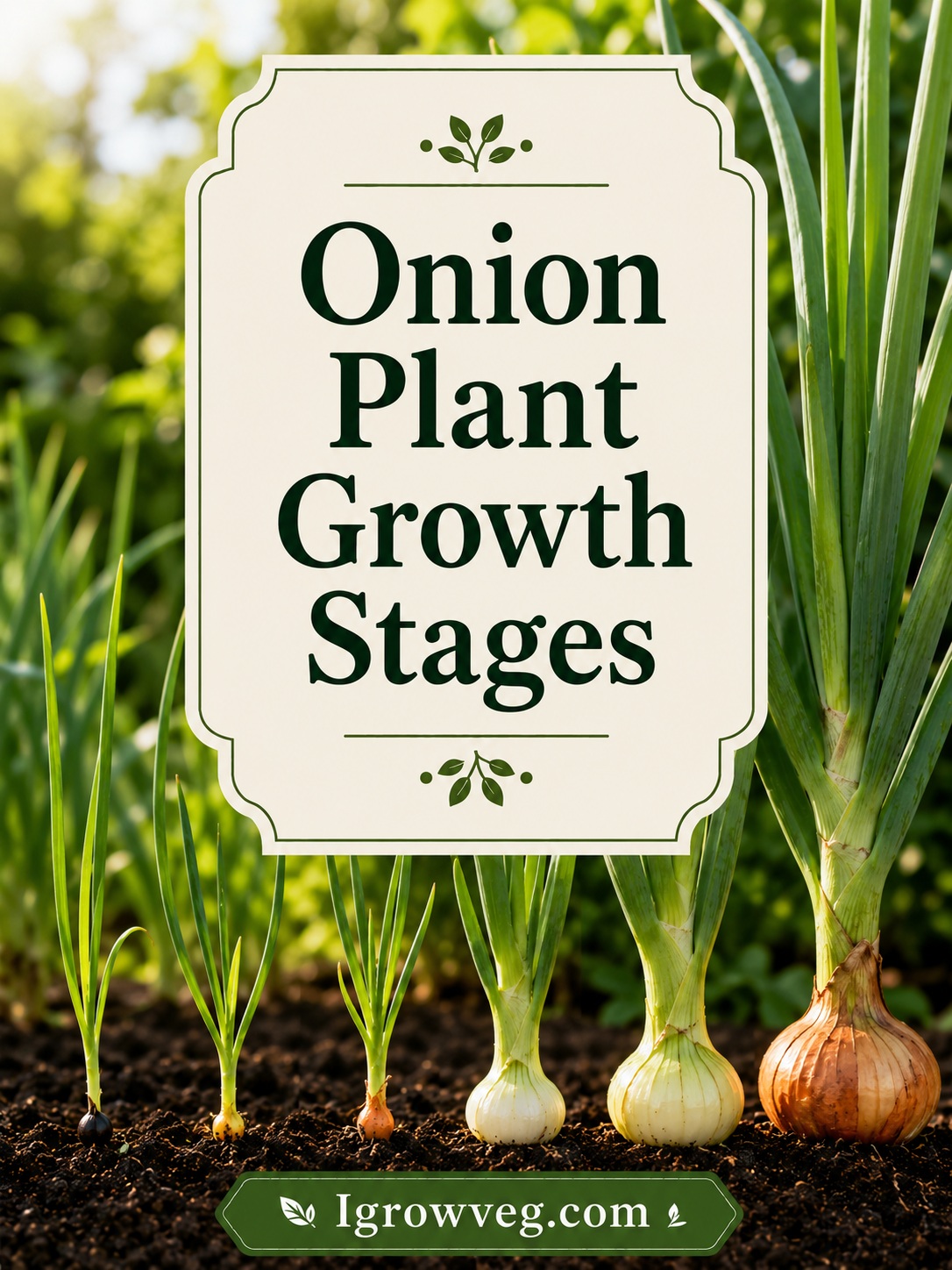
The onion plant growth stages represent a unique biological timeline that every gardener must understand to produce large, flavorful bulbs. These plants (Allium cepa) are biennial by nature, although most cultivators grow them as annuals for their edible bulbs. Unlike many garden vegetables, onions rely heavily on day length and light intensity to trigger specific developmental milestones.
From the moment the first “loop” emerges from the soil to the eventual drying of the foliage, the plant follows a strict physiological program. By mastering these transitions, you can provide the specific nutrients and water required at each step to ensure a bountiful harvest. In this extensive guide, we will explore the six primary milestones of onion development and how you can optimize your garden for success.
🧅 Onion Plant Growth Stages
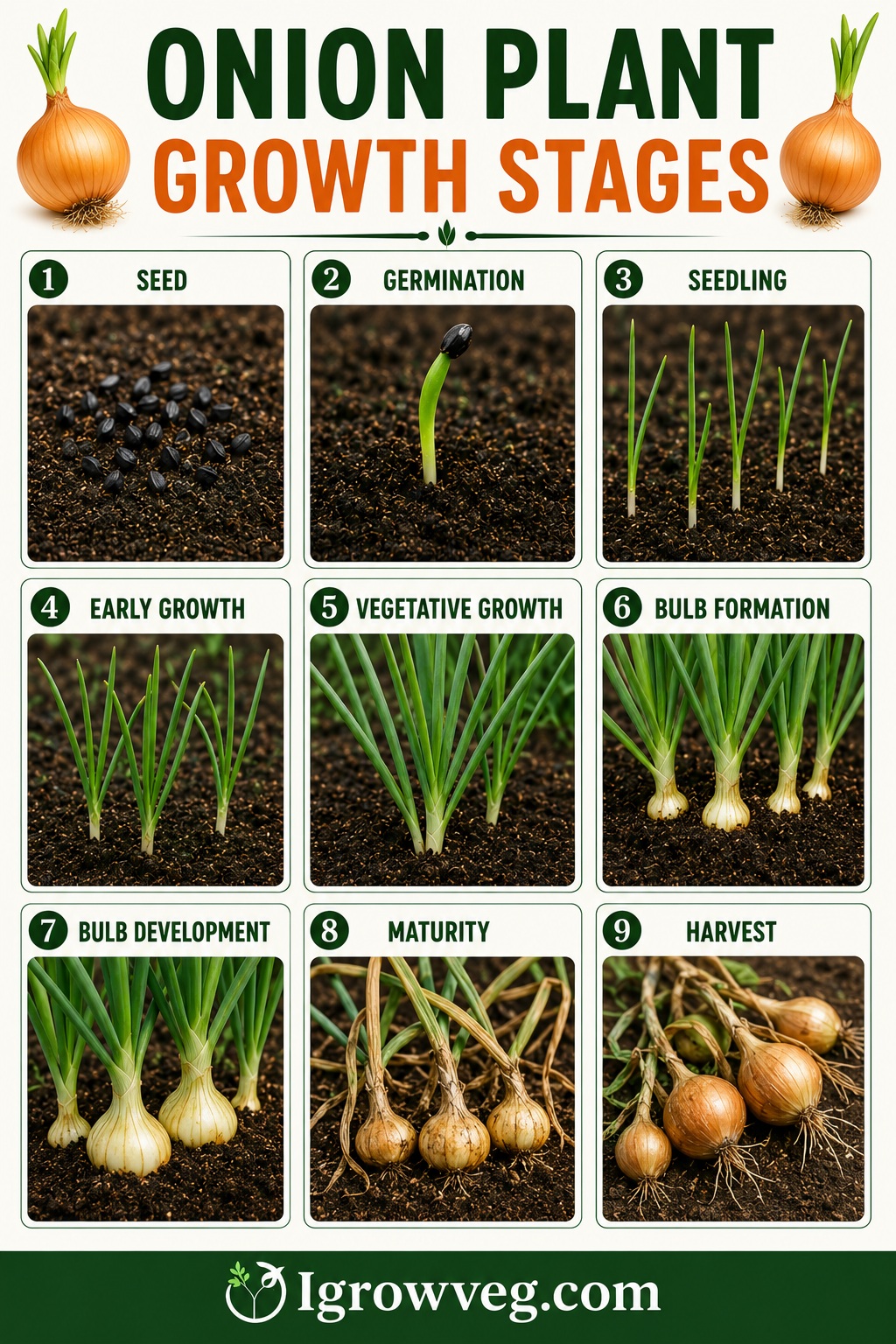
- Seed Germination (7–14 days) Seeds sprout; cotyledons emerge; first true leaves appear.
- Seedling Stage (2–4 weeks) Thin, grass-like leaves develop; roots establish; plant remains small and delicate.
- Juvenile Vegetative Growth (4–8 weeks) Leaves elongate and multiply; photosynthesis increases; bulb initiation begins underground.
- Bulb Initiation Stage (8–12 weeks) Leaf bases thicken; bulb formation starts as day length and temperature influence growth.
- Bulb Development Stage (12–16 weeks) Bulbs enlarge; outer scales form; foliage continues to support bulb growth.
- Maturation Stage (16–20 weeks) Leaves begin to yellow and topple; bulbs reach full size and develop papery skins.
- Harvest Stage (20–24 weeks) Bulbs are lifted once tops dry; cured in sun or ventilated space to harden skins.
- Dormancy / Storage Stage Properly cured onions can be stored for months in cool, dry, ventilated conditions.
🌿 Notes:
- Onions are day-length sensitive: short-day types suit tropical/subtropical regions, while long-day types thrive in temperate climates.
- Consistent watering is crucial during bulb formation, but reduce irrigation before harvest to prevent rot.
- Crop rotation helps avoid soil-borne diseases like white rot.
1. Germination: The “Loop” and Initial Sprouting
The first of the onion plant growth stages begins with the “awakening” of the seed or the dormancy break of a set. Most gardeners choose between seeds, sets (small bulbs), or transplants. Each starting point influences the speed of the germination phase.
The Seed Perspective
Onion seeds are relatively short-lived and require consistent moisture and moderate temperatures to sprout. Ideally, soil temperatures should range between 10°C and 25°C. During the first 7 to 14 days, the seed absorbs water and the primary root (radicle) emerges. Shortly after, the “loop” or “knee” appears above the soil. This is the cotyledon, which acts as a bridge between the seed and the atmosphere.
The “Flag” Stage
As the cotyledon straightens, it pulls the seed coat out of the ground, looking like a tiny green flag. This is a delicate moment in the onion plant growth stages. The plant lacks a true leaf at this point and relies entirely on the energy stored within the seed. Furthermore, the soil must remain friable; if the soil crusts over, the fragile loop may snap before it can fully straighten.
2. Vegetative Growth: The Rule of Leaf Development
Once the first true leaf emerges, the plant enters the vegetative phase. This is arguably the most critical of the onion plant growth stages for determining the final size of your harvest.
The Correlation Between Leaves and Layers
In the world of onions, there is a golden rule: each leaf represents one layer of the onion bulb. Therefore, a plant with thirteen leaves will produce an onion with thirteen layers. To grow a massive bulb, you must encourage as much leaf growth as possible before the plant begins to form the bulb. This requires high levels of nitrogen and consistent moisture.
Building the Solar Factory
During this stage, the onion plant acts as an energy factory. The leaves capture sunlight and convert it into carbohydrates, which the plant eventually stores in the bulb. If the plant suffers from pest damage or nutrient deficiencies during this window, it will produce fewer leaves and, consequently, a smaller bulb. For high-quality organic gardening advice on nitrogen-rich soil amendments, The Old Farmer’s Almanac provides excellent resources for seasonal planting and soil preparation.
3. The Critical Transition: Understanding Onion Plant Growth Stages and Photoperiodism
The most complex part of the onion plant growth stages involves photoperiodism, or the plant’s response to the length of the day. Unlike many plants that flower based on age, onions form bulbs based on how many hours of daylight they receive.
Short-Day vs. Long-Day Onions
Gardeners must choose the correct variety for their latitude to ensure successful bulbing.
- Short-Day Onions: These begin the bulbing process when they receive 10 to 12 hours of daylight. They thrive in southern climates where winter days are relatively long.
- Long-Day Onions: These require 14 to 16 hours of daylight to start bulbing. They are the standard for northern regions with long summer days.
- Intermediate Onions: These fall in the middle, requiring 12 to 14 hours of light.
The Signal to Stop Leaf Growth
When the plant receives the specific light signal, it stops producing new leaves and begins to divert all its energy into the leaf bases. These bases swell and expand, forming the bulb. If you plant a long-day onion in a short-day region, the plant may grow beautiful leaves but will never receive the signal to form a bulb. Similarly, planting a short-day onion too late in a northern climate will result in premature, tiny bulbs.
4. The Bulbing Stage: Expansion and Nutrient Storage
During the bulbing phase of the onion plant growth stages, the “neck” of the plant stays thick while the base expands. This is the period of maximum carbohydrate transfer.
Changing Nutrient Needs
As the bulb swells, the plant’s demand for nitrogen decreases, while its demand for phosphorus and potassium increases. Excessive nitrogen at this stage can actually be detrimental; it may encourage the plant to keep producing leaves instead of finishing the bulb, leading to “thick necks” that do not store well.
Moisture Consistency
Consistent watering is paramount during bulb expansion. If the soil dries out and then becomes suddenly saturated, the bulb may “split” or “double,” which reduces its storage life. For detailed technical data on irrigation management and soil science for root crops, the University of California Agriculture and Natural Resources offers extensive research into commercial and home-scale vegetable physiology.
5. Maturation: The Soft Neck and “Fall Over”
The penultimate milestone in the onion plant growth stages is maturation. This is the signal that the plant has finished its lifecycle for the season and is ready for dormancy.
The “Neck Drop”
You will know your onions are maturing when the green tops begin to yellow and lose their turgidity. Eventually, the neck of the onion softens, and the foliage collapses or “falls over” onto the ground. This is a natural process where the plant seals off the bulb from the atmosphere to protect it from pathogens.
Withholding Water
Once about 50% of your onion tops have fallen over, you should stop watering entirely. Allowing the soil to dry out helps the outer skins of the onion—the tunics—to toughen and cure. Harvesting while the soil is wet can lead to rot and fungal issues during storage.
6. Curing and Storage: The Post-Harvest Stage
Although the plant is no longer “growing” in the traditional sense, curing is the final essential part of the onion plant growth stages.
The Drying Process
After lifting the onions from the ground, you must cure them in a dry, well-ventilated area away from direct sunlight. Curing allows the outer layers to dry into a protective, papery skin and ensures the neck is completely sealed. This process typically takes two to three weeks. A properly cured onion will have a “clink” sound when you handle it, indicating that the moisture has successfully left the outer tunics.
Troubleshooting Growth Stages
Throughout these stages, you may encounter “bolting.” Bolting occurs when the onion plant produces a flower stalk instead of a bulb. This usually happens due to a sudden cold snap followed by warm weather, which tricks the biennial plant into thinking it has passed through a winter. If your onion bolts, harvest it immediately and eat it fresh, as bolted onions do not store well.
Summary of Onion Development Milestones
| Stage | Approximate Timeline | Key Growth Indicator |
| Germination | 7–14 Days | Emergence of the “loop” and cotyledon. |
| Vegetative | Weeks 3–12 | Rapid leaf production; each leaf = a layer. |
| Bulb Initiation | Varies by Day Length | Swelling of the leaf bases at the soil line. |
| Bulb Expansion | Weeks 12–18 | Rapid increase in bulb diameter; high potassium. |
| Maturation | Week 18+ | Tops turn yellow and fall over (neck drop). |
| Curing | Post-Harvest | Drying of tunics and sealing of the neck. |
Conclusion
Understanding the onion plant growth stages is the difference between a harvest of “spring onions” and a cellar full of massive, storage-ready bulbs. From the patient observation of the germination loop to the strategic management of leaf growth and the critical timing of the “neck drop,” every phase requires a specific approach.
By selecting the correct variety for your latitude and providing the right nutrients at the right time, you can navigate the complex photoperiodic needs of this ancient crop. Ultimately, the success of your onion patch depends on your ability to work in harmony with the plant’s natural rhythm, ensuring that each leaf is a stepping stone to a perfect, crunchy bulb.
FAQ: Frequently Asked Questions
1. How long do onion plant growth stages usually last?
Depending on the variety and whether you start from seed or set, the process typically takes 100 to 175 days.
2. Why are my onions so small even though the tops look healthy?
This usually happens if you planted the wrong variety for your latitude (e.g., planting long-day onions in a short-day region).
3. Should I push the onion tops over myself to speed up ripening?
No. You should allow the tops to fall over naturally, as this indicates the plant has finished transferring nutrients to the bulb.
4. What causes an onion to bolt (flower)?
Bolting is typically caused by temperature fluctuations or stress, which tricks the plant into completing its biennial cycle early.
5. Can I eat onions at any of the growth stages?
Yes! You can harvest them as “green onions” during the vegetative stage or as “boilers” during early bulb expansion.
6. Why do my onions have thick necks that won’t dry?
Thick necks often result from excessive nitrogen application late in the bulbing stage or improper variety selection.
7. How much sun do onion plant growth stages require?
Onions need full sun (at least 6–8 hours daily) to produce enough energy for bulb development.
8. How do I store onions after the final growth stage?
Store them in a cool, dry, dark place with excellent airflow, such as a mesh bag or a slatted wooden crate.
9. Do onions need a lot of water?
They have shallow roots and need consistent moisture, especially during the bulbing phase, to prevent splitting.
10. Can I grow onions from the bottom of a store-bought onion?
You can grow the greens, but it is very difficult to produce a new, high-quality bulb this way compared to using seeds or sets.