The banana plant growth stages reveal one of nature’s most impressive feats of rapid expansion. Although many people refer to them as trees, bananas (Musa) are actually the world’s largest perennial herbs. They do not possess a woody trunk; instead, they grow from a succulent “pseudostem” made of tightly packed leaf bases.
Understanding the lifecycle of this tropical giant is essential for anyone hoping to see a bunch of fruit. Because the plant grows so quickly—often reaching full height in under a year—it requires specific nutrients and care at every transition. This guide explores the biological milestones of the banana, helping you navigate the journey from a tiny sprout to a towering, productive plant.
🍌 Banana Plant Growth Stages
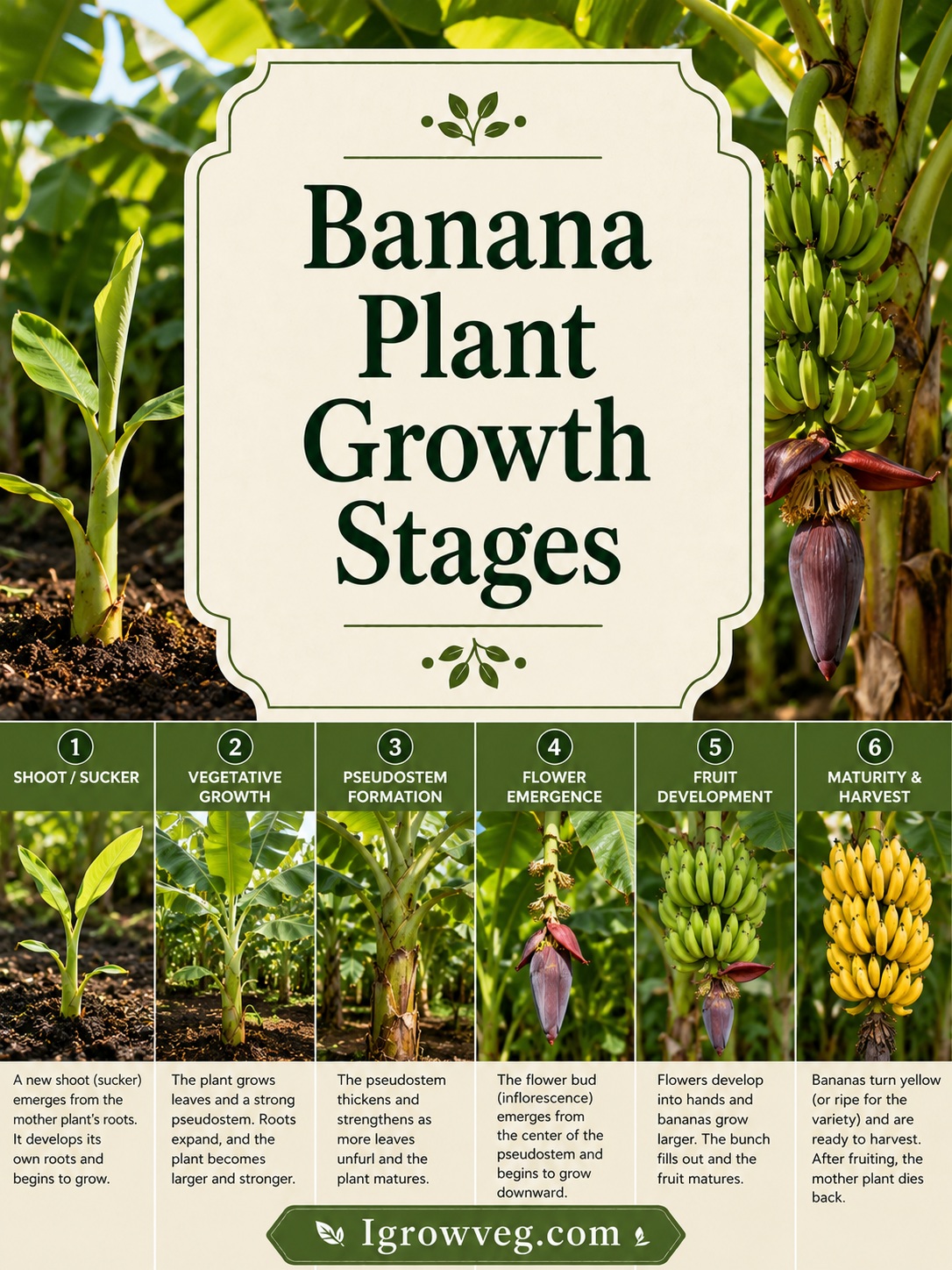
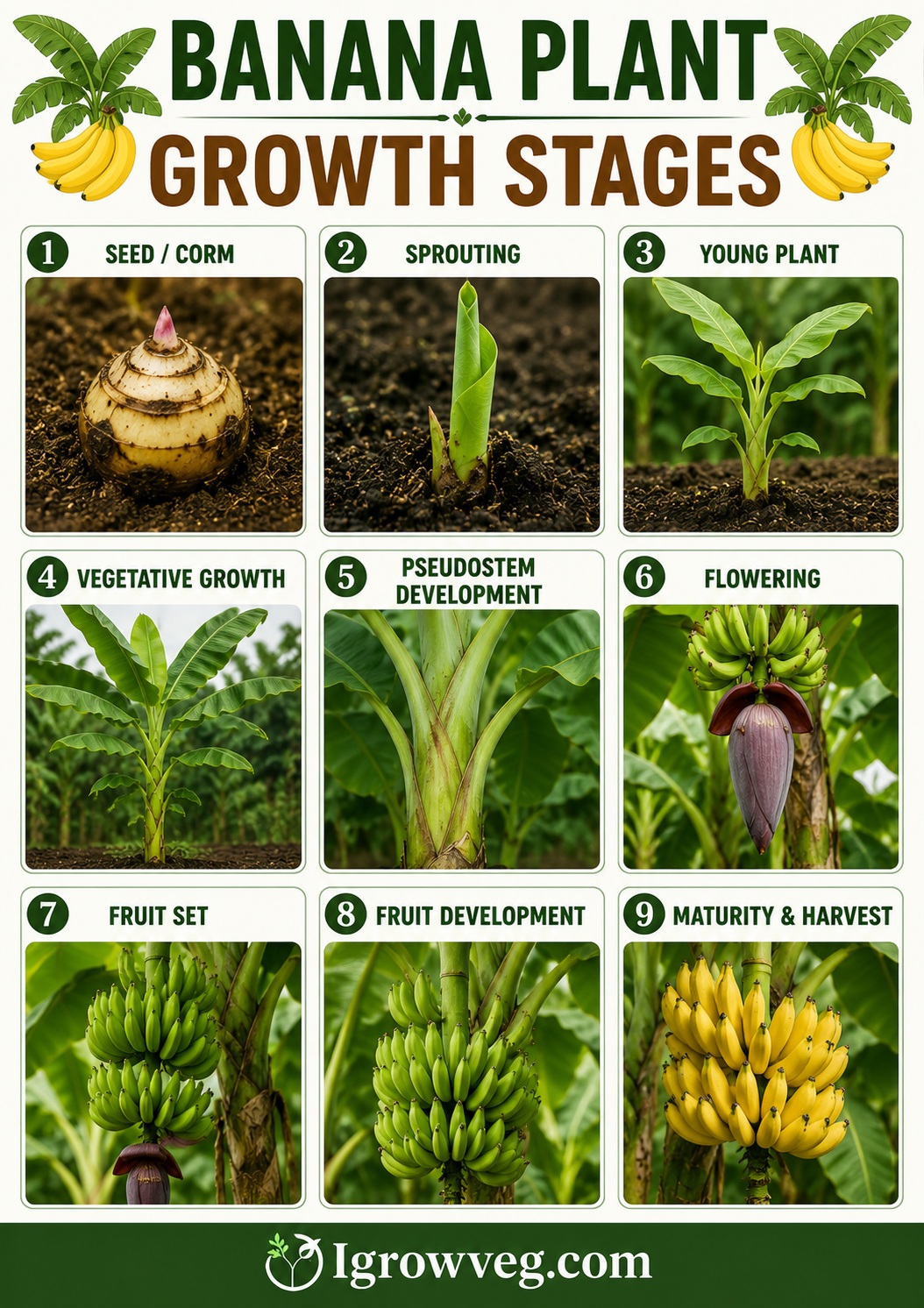
- Seed Germination / Rhizome Sprouting (2–4 weeks) Growth begins from underground rhizomes or suckers; shoots emerge above soil.
- Seedling Stage (1–3 months) Young pseudostem develops; first leaves appear; roots establish.
- Vegetative Growth (3–9 months) Rapid leaf production; pseudostem thickens; plant height increases significantly.
- Flower Initiation (9–12 months) Inflorescence (flower stalk) emerges from the pseudostem; bracts open to reveal flowers.
- Flowering Stage (12–15 months) Male and female flowers develop; female flowers form fruit clusters (hands).
- Fruit Development (3–6 months after flowering) Bananas enlarge, change from angular to rounded; bunches mature.
- Ripening Stage (15–18 months total) Fruits turn yellow (or red/purple depending on variety); starch converts to sugars.
- Mature Plant / Senescence (18+ months) Mother plant dies after fruiting; new suckers (daughter plants) continue the cycle.
🌿 Notes:
- Bananas are perennial herbs, not true trees.
- Productivity depends on healthy rhizomes and sucker management.
- Each pseudostem fruits once, then dies, replaced by new shoots.
1. The Vegetative Phase: The Rise of the Pseudostem
The first of the banana plant growth stages begins with a “sucker” or a “bit” (a piece of the underground rhizome). This stage focuses entirely on building the physical structure of the plant.
The Emergence of the Sucker
New plants usually emerge from the base of a “mother” plant. These young shoots, known as “sword suckers,” feature narrow leaves and a strong connection to the parent’s nutrient-rich rhizome. During these first few months, the plant establishes its own root system.
Leaf Production and Pseudostem Height
As the plant grows, it produces a new leaf every 7 to 10 days. Each leaf emerges from the center of the plant as a tightly rolled cylinder before unfurling into a massive, wind-catching sail. The height of the pseudostem determines the eventual size of the fruit bunch. During this high-growth period, the plant requires immense amounts of water and nitrogen. To learn more about the soil chemistry required for tropical herbs, The Royal Botanic Gardens, Kew provides extensive data on Musa species and their ecological needs.
2. The Flowering Phase: The “Heart” Emerges
Transitioning from leaf production to flowering is the most dramatic shift in the banana plant growth stages. At this point, the plant stops producing new leaves entirely.
The Emerging Inflorescence
After roughly 10 to 14 months of growth, the true stem grows up through the center of the pseudostem. It eventually emerges at the top as a large, purple, teardrop-shaped bud known as the “banana heart.” This bud hangs downward due to its weight.
Female, Neutral, and Male Flowers
As the bracts (petals) of the heart peel back, they reveal clusters of flowers. The first flowers to appear are female. These are the flowers that eventually transform into the fruit we eat. Following the female flowers, “neutral” flowers appear, which usually drop off. Finally, at the very tip of the hanging stalk, the male flowers emerge. In commercial edible bananas, the fruit develops through parthenocarpy, meaning it doesn’t require pollination to grow.
3. Fruit Development: The “Hands” and “Fingers”
Once the female flowers are exposed, the third milestone of the banana plant growth stages begins: the swelling of the fruit.
Defining the Bunch
Each cluster of bananas is known as a “hand,” while an individual banana is called a “finger.” A healthy plant can produce anywhere from 5 to 20 hands in a single bunch. During this stage, the fruit is green, hard, and points downward.
Geotropism: The Upward Curve
A unique phenomenon called “negative geotropism” occurs during this phase. As the bananas grow, they begin to curve upward against gravity, reaching toward the sunlight. This gives the fruit its characteristic curved shape. The plant requires significant potassium during this stage to fill the fruit with starches and sugars. For expert advice on organic potassium amendments like wood ash or kelp, National Gardening Association is a fantastic resource.
4. Maturation and Harvest: Reaching Culinary Perfection
The final phase of the banana plant growth stages involves the maturation of the fruit and the eventual death of the pseudostem.
Sizing and “Plumping”
The fruit is ready for harvest when it loses its angular ribs and becomes rounded or “plump.” Most growers harvest the bunch while it is still green. If you leave the fruit to ripen on the plant, it often splits and attracts insects or birds.
The End of the Cycle
The banana plant is “monocarpic,” meaning the individual pseudostem dies after fruiting. Once you harvest the bunch, you must cut the pseudostem down to the ground. This allows the sun to reach the next generation of “suckers” already waiting at the base, starting the entire cycle over again.
5. Summary of Banana Growth Milestones
| Stage | Approximate Timeline | Physical Indicators |
| Sucker/Juvenile | Months 1–6 | Rapid leaf production; establishment of roots. |
| Vegetative Peak | Months 6–10 | Pseudostem reaches full height; massive leaves. |
| Flowering | Months 10–12 | Emergence of the “heart” and female flowers. |
| Fruiting | Months 12–15 | Fingers swell and curve upward (geotropism). |
| Harvest | Month 15+ | Fruit is rounded; pseudostem is cut back. |
Conclusion
The banana plant growth stages represent an incredible cycle of renewal and speed. From a tiny sword sucker to a fruit-laden giant, the plant manages its energy with precision. By understanding the shift from nitrogen-heavy vegetative growth to the potassium-demanding fruiting phase, you can ensure your plant has the resources it needs to produce a heavy harvest. Remember that while the parent plant dies, its legacy lives on in the suckers at its base, ensuring your tropical garden continues to thrive year after year.
FAQ: Frequently Asked Questions
1. How long does it take for a banana plant to produce fruit?
Depending on the variety and climate, it usually takes between 10 to 15 months from planting to harvest.
2. Why are my bananas small and not filling out?
This is often caused by a lack of water or a deficiency in potassium during the fruit development stage.
3. Do I need to cut down the plant after harvesting the bananas?
Yes, the fruiting stem will die anyway, so cutting it down encourages the growth of new suckers.
4. Can banana plants grow in cold climates?
While most prefer the tropics, some varieties like Musa basjoo are cold-hardy, though they may not produce edible fruit in cold zones.
5. How much water does a banana plant need?
They are very thirsty plants; they require deep, consistent watering, especially during the hot summer months.
6. What is the “banana heart”?
It is the large, purple flower bud that emerges from the top of the plant before the fruit begins to grow.
7. Should I remove the extra suckers?
Yes, most growers keep only one “successor” sucker per plant to ensure all energy goes into the main fruit bunch.