

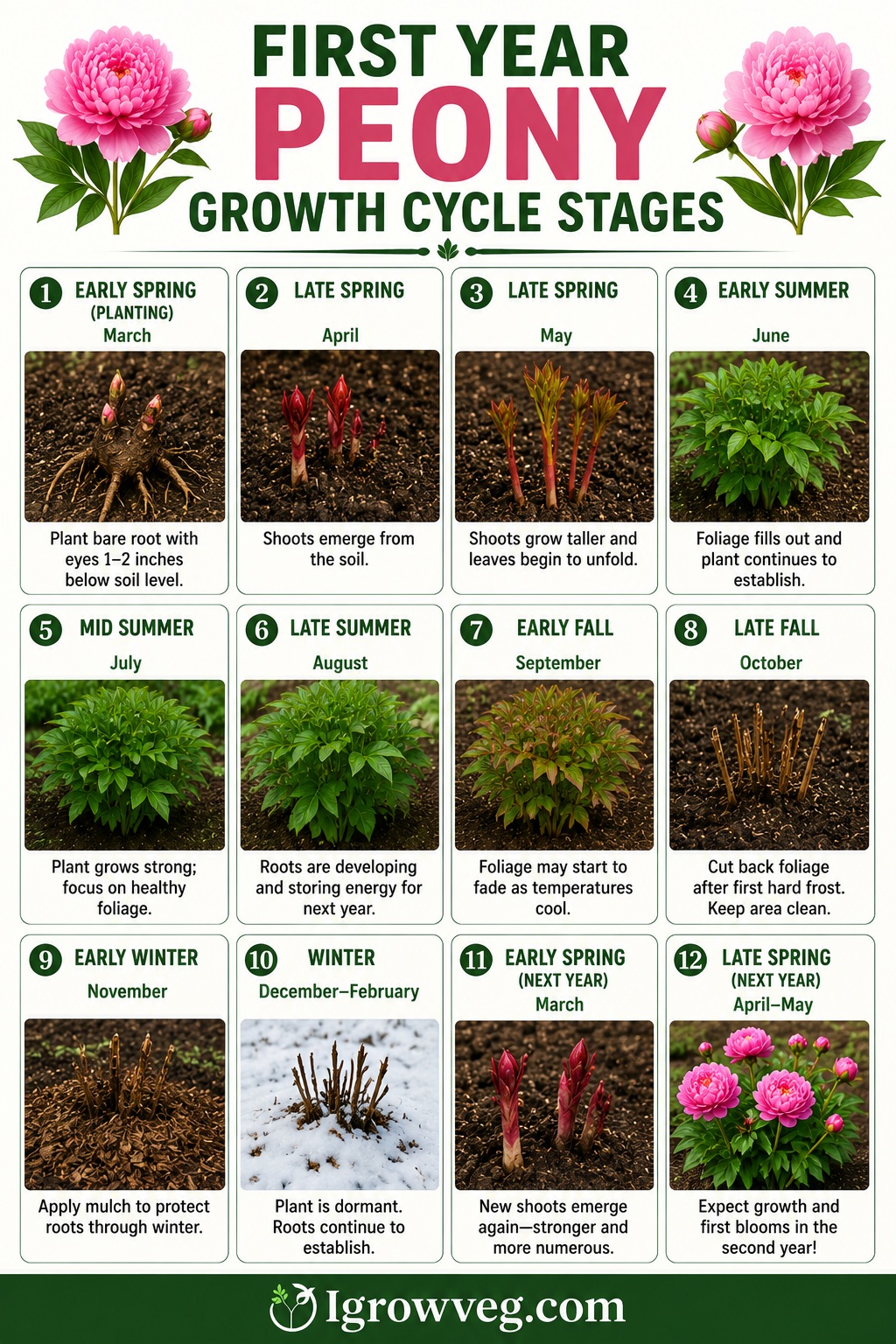
The first year peony growth cycle stages are governed by a famous gardening adage: “The first year they sleep, the second year they creep, and the third year they leap.” Unlike annuals that rush to flower in a single season, peonies (Paeonia) are long-lived perennials that can thrive in the same spot for 50 years or more. Because of this longevity, the first 12 months are dedicated almost entirely to underground development.
For a new gardener, this phase can be deceptive; while there may be little to see above the soil, the plant is performing a complex biological “onboarding” process. Understanding these milestones is essential for managing expectations and ensuring the plant has the structural integrity to support its massive, heavy blooms in the years to come.
🌸 First-Year Peony Growth Cycle Stages
- Dormant Root Stage (Winter, before planting) Peony roots (often bare-root divisions) remain dormant until planted in early spring or autumn.
- Sprouting Stage (Early Spring) Red or pink shoots emerge from the soil as temperatures rise; stems begin to elongate.
- Leaf Development Stage (Spring) Compound leaves unfurl, providing energy through photosynthesis; plant focuses on root establishment rather than flowering.
- Vegetative Growth Stage (Late Spring–Summer) Stems strengthen, foliage expands; roots and crown develop underground. Most first-year peonies do not flower, as energy is directed to root establishment.
- Root Expansion Stage (Summer–Autumn) Underground tuberous roots thicken and store nutrients; crown buds form for next year’s growth.
- Dieback Stage (Late Autumn) Above-ground stems and leaves yellow, then die back completely; plant enters dormancy.
- Dormancy Stage (Winter) Plant rests underground with buds protected in the crown, preparing for vigorous growth and flowering in the second year.
🌿 Notes:
- First-year peonies rarely bloom; the focus is on root and crown establishment.
- Proper planting depth (2–5 cm of soil above crown buds) is critical for future flowering.
- Patience is key—peonies often take 2–3 years to reach full blooming potential.
1. Planting and Initial Dormancy (Autumn to Winter)
The first of the first year peony growth cycle stages usually begins in the fall. Peonies are most successful when planted as bare roots—fleshy storage structures with “eyes” (buds)—rather than potted plants.
Setting the Depth
During this stage, the plant is dormant, but the placement is critical. The “eyes” must be planted no deeper than 1 to 2 inches below the soil surface. If planted too deep, the peony may grow lush foliage in the spring but will never produce flowers. During the winter, the cold temperatures (vernalization) are actually necessary to trigger the developmental signals for the following spring.
Root Acclimation
While the top of the plant is invisible, the bare root is beginning to interface with the surrounding soil. It is a period of quiet transition where the plant adjusts to the local soil chemistry and drainage. For professional guidance on soil preparation and the specific phosphorus needs of perennial roots, Purdue offers extensive resources on Paeonia cultivation.
2. Spring Emergence: The “Red Pip” Stage
As the soil warms in early spring, the second milestone of the first year peony growth cycle stages appears. This is often the most exciting moment for a new peony owner.
The Appearance of Pips
Instead of green leaves, peonies emerge as bright red or burgundy spears known as “pips.” These pips are highly pressurized bundles of stems and leaves. Their dark pigmentation is a natural defense mechanism, protecting the tender new growth from late frosts and intense UV light.
Rapid Vertical Stretch
During this window, the pips expand rapidly, often growing several inches in a single week. As the stems lengthen, the red tint gradually fades into a deep, glossy green. Even in the first year, the plant will attempt to establish its characteristic bushy shape, though it will be significantly smaller than a mature specimen.
3. Leaf Development: The Solar Factory
By late spring, the plant enters the vegetative phase of the first year peony growth cycle stages. Since the plant is unlikely to produce a strong flower, the leaves are its most important asset.
Photosynthetic Priority
Peony leaves are broad and deeply lobed, designed to capture maximum sunlight. In the first year, the plant is focused on “recharging” the root. The sugars produced in these leaves are sent downward to expand the rhizome and create more “eyes” for the following year.
Managing Foliage Health
Because the first-year plant is small, it is vital to protect the leaves from fungus like Botrytis (gray mold). Providing good air circulation and avoiding overhead watering ensures that the “solar factory” remains efficient throughout the summer. To learn more about the ecological role of perennials in supporting local pollinators, The National Gardening Association provides excellent data on garden biodiversity.
4. The “No-Bloom” Rule: Energy Conservation
One of the most misunderstood parts of the first year peony growth cycle stages is the absence of flowers.
Bud Formation (Or Lack Thereof)
It is common for a first-year peony to produce a tiny, pea-sized bud that never opens, or it may not produce a bud at all. This is perfectly normal. The plant is intelligently diverting its limited resources into root expansion rather than the “expensive” biological cost of a bloom.
The Sacrifice for Success
If your first-year peony does manage to produce a flower, many expert growers recommend clipping the bud off before it opens. While difficult for the gardener, this ensures that the energy that would have gone into the flower is instead “invested” back into the root system, resulting in a much stronger plant in the second and third years.
5. Summer Root Deepening and Heat Management
As the heat of summer sets in, the above-ground growth of the first year peony growth cycle stages slows down significantly, but the underground activity intensifies.
Rhizome Expansion
The fleshy roots begin to store starches and nutrients. They also begin to form the buds for next year’s growth. These “eyes” for the following spring are actually formed in the late summer of the previous year.
Hydration and Mulch
First-year peonies have shallow root systems compared to established plants. They require consistent moisture during the “dog days” of summer. However, they are prone to root rot, so the soil must be well-draining. A light layer of mulch can help retain moisture, but it must be kept away from the crown (the center of the plant) to prevent fungal issues.
6. Autumn Senescence: Returning to the Earth
The final phase of the first year peony growth cycle stages is senescence—the natural yellowing and death of the foliage as the plant prepares for winter.
Nutrient Reabsorption
As the days shorten, the peony pulls the remaining nutrients from its leaves back into the rhizome. The leaves may turn yellow, bronze, or even spotted. Once the foliage has completely withered after the first hard frost, it should be cut back to about 2 inches above the ground.
Clearing Debris
Removing the first-year foliage is a critical hygiene step. It removes any lingering pathogens or pests that might try to overwinter in the leaf litter, ensuring the plant starts its second year (the “creep” phase) in a clean environment.
Summary of First-Year Peony Development
| Stage | Approximate Timeline | Key Growth Indicator |
| Dormancy | Nov – Feb | Underground acclimation; eyes remain dormant. |
| Emergence | March – April | Bright red “pips” break through the soil. |
| Vegetative | May – June | Leaves unfurl; plant reaches 10–18 inches. |
| Reproductive | June | Rare/small buds; usually better to remove them. |
| Storage | July – Sept | Roots store energy; next year’s eyes form. |
| Senescence | Oct – Nov | Foliage dies back; plant is cut to the ground. |
Conclusion
The first year peony growth cycle stages are a lesson in patience and long-term planning. By focusing on root health and leaf efficiency rather than immediate floral gratification, you are setting the stage for a plant that will eventually produce dozens of fragrant, plate-sized blooms.
While the “sleeping” year may seem quiet, it is the most transformative period in the plant’s life. With proper depth control, consistent summer moisture, and the strategic removal of early buds, you can ensure your peony moves successfully into its “creep” and “leap” years, becoming a cornerstone of your garden for decades to come.
FAQ: Frequently Asked Questions
1. Why didn’t my peony bloom in its first year?
Peonies almost never bloom in their first year. They are focusing all their energy on establishing a root system to support future growth.
2. My peony shoots are bright red. Is something wrong?
No, this is perfectly normal. Peony “pips” are naturally red or burgundy to protect them from cold and UV light; they will turn green as they grow.
3. Should I fertilize my first-year peony?
A light application of a low-nitrogen, high-phosphorus fertilizer in the spring is helpful, but avoid over-fertilizing, which can cause weak growth.
4. How much water does a first-year peony need?
They need about an inch of water per week. Because their roots are still shallow, they are less drought-tolerant than mature peonies.
5. Can I move my peony if I don’t like where I planted it?
Peonies hate being moved. If you must move it, wait until the fall, but be aware that moving it will “reset” the growth cycle back to the first year.
6. Do I need to stake a first-year peony?
Usually not. Since they are smaller and unlikely to have heavy flowers in the first year, their stems are strong enough to stand on their own.
7. Why are the leaves on my peony turning brown in August?
This could be a sign of drought stress or a fungal issue like powdery mildew. Ensure consistent watering and good airflow.
8. What are the “eyes” on a peony root?
The eyes are the small, pinkish buds on the rhizome. Each eye represents a potential stem for the following spring.
9. Can I grow peonies in warm climates?
Most peonies need a cold winter to bloom. However, some “intersectional” (Itoh) varieties are more tolerant of milder winters.
10. Is it okay to leave the dead leaves on the ground over winter?
No. Always cut them back and remove them to prevent disease from affecting the plant the following year.