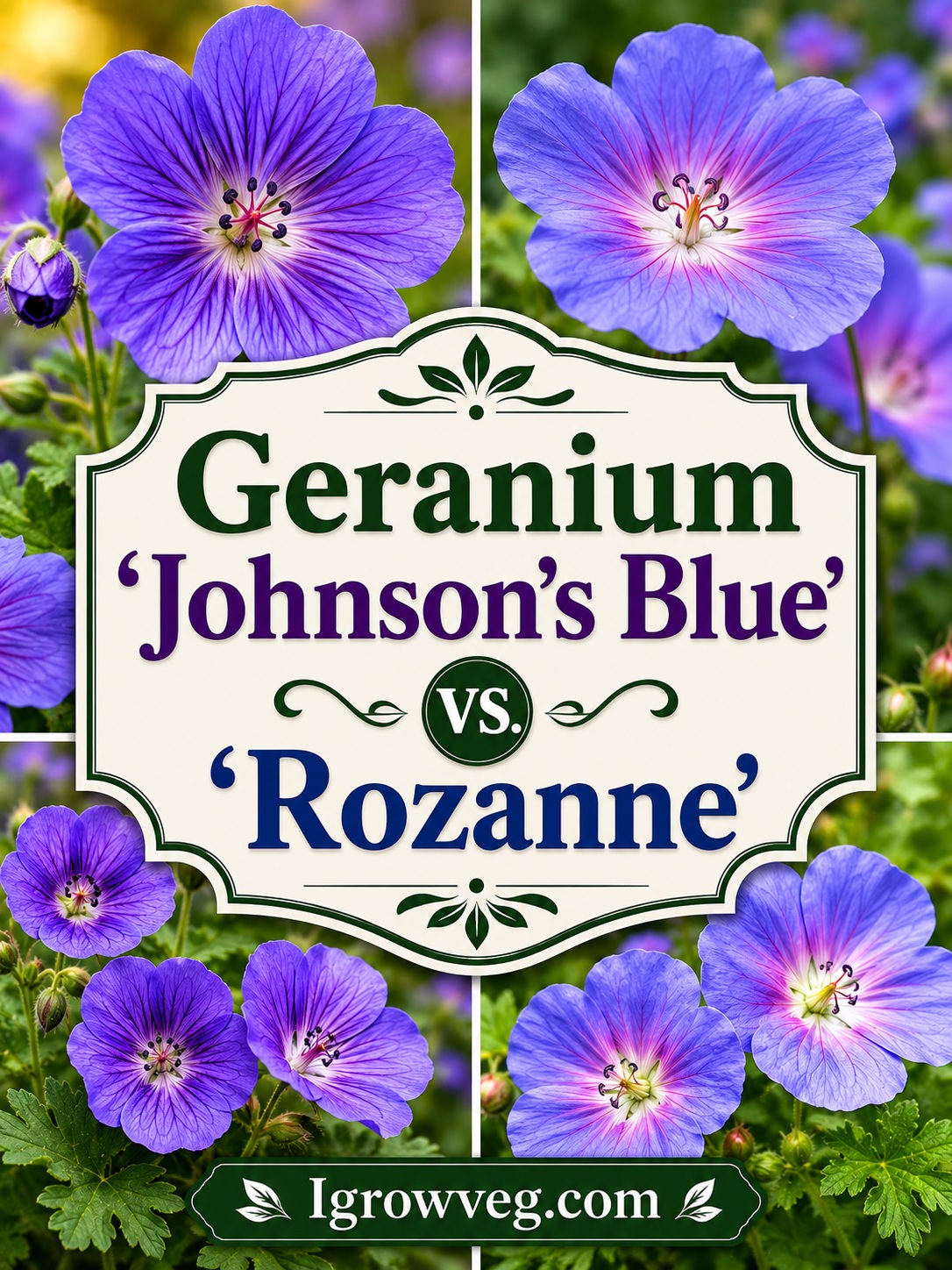
Hardy cranesbills (the genus Geranium) are the unsung heroes of the cottage garden boarder. Unlike their tender, frost-sensitive cousins (Pelargonium), true hardy geraniums form resilient underground root systems that endure freezing winters, returning year after year to choke out weeds, soften hard edges, and blanket landscapes in cool-toned color.
When gardeners seek out a dependable, blue-flowered perennial groundcover, two names consistently dominate nursery catalogs and landscape designs: Geranium ‘Johnson’s Blue’ and Geranium ‘Rozanne’ (sometimes sold under its cultivar name, Geranium ‘Gerwat’).
While both cultivars boast beautiful blue-lavender blossoms and deeply dissected green foliage, they behave like entirely different plants in the garden. One is a classic, early-summer sprinter that dates back decades, while the other is a modern, sterile hybrid powerhouse that single-handedly redefined perennial breeding standards. Choosing the wrong one for your specific garden layout can result in unexpected empty spaces mid-summer or, conversely, a massive carpet of vines smothering your nearby delicate alpine plants.
This comprehensive guide analyzes the genetic history, growth habits, floral traits, and care requirements of ‘Johnson’s Blue’ and ‘Rozanne’ to help you select the ideal perennial for your backyard ecosystem.
1. Genetic Lineage and Breeding History
To understand why these two plants grow so differently, you must look at their parentage. Their genetic blueprints dictate their flowering window, heat tolerance, and structural growth.
Geranium ‘Johnson’s Blue’
Introduced in the mid-20th century, ‘Johnson’s Blue’ is a historic hybrid resulting from a cross between two European native species: Geranium pratense (the meadow cranesbill) and Geranium喜马拉雅山脉/himalayense (the Himalayan cranesbill).
- The Inheritance: From its G. pratense lineage, it inherits a upright, clump-forming frame and a highly structured, deeply divided leaf architecture.
- The Legacy: For decades, it stood unchallenged as the truest “blue” available in the genus, celebrated for its intense color saturation and traditional cottage garden aesthetic.
Geranium ‘Rozanne’
Discovered as a chance seedling in a Somerset, England garden by Rozanne and Donald Waterer in 1989, this plant completely upended the horticultural industry. It is a cross between the large-flowered Geranium himalayense and a rare, late-blooming species native to the Himalayas, Geranium wallichianum ‘Buxton’s Variety’.
- The Inheritance: From G. wallichianum, ‘Rozanne’ inherited an unprecedented tolerance for summer heat, a sprawling vining habit, and a unique genetic mutation: absolute sterility.
- The Recognition: Because the plant cannot produce seeds, it spends zero energy on seed production, allowing it to bloom continuously from late spring until the first hard frost of winter. This trait earned ‘Rozanne’ the Royal Horticultural Society’s (RHS) prestigious “Plant of the Centenary” award in 2013.
2. Morphology: Visual Identification and Growth Habits
At a casual glance in a nursery pot, these two cranesbills look identical. However, once established in the ground, their structural habits part ways completely.
Foliage and Frame Structure
- ‘Johnson’s Blue’ develops a highly contained, upright mound. It grows to a predictable height of 12 to 18 inches and stretches roughly 18 to 24 inches wide. Its leaves are deeply divided into slender, sharp, tooth-like segments, giving the plant a refined, lace-like appearance.
- ‘Rozanne’ behaves much more like a scrambling groundcover. While it tops out at a similar height of 15 to 20 inches, its stems are long, lax, and spreading, easily running 24 to 36 inches ($60\text{–}90\text{ cm}$) outward in a single season. The foliage is broader, displaying a distinct chartreuse or marbled yellow-green mottling against mid-green lobes, which turn a rich coppery-bronze color in autumn.
Floral Anatomy and Color Variations
- ‘Johnson’s Blue’ produces clusters of cup-shaped, un-lobed flowers. The color is a luminous lavender-blue that lacks a prominent white center, though it features incredibly delicate, dark reddish-purple veins radiating from the core across the petals. The flowers sit proudly above the foliage on rigid stems.
- ‘Rozanne’ features slightly larger, saucer-shaped blossoms (up to 2 inches across). The color leans toward a vibrant, electric violet-blue. The defining visual marker for ‘Rozanne’ is its bright white eye at the center of each blossom, which is sharply framed by deep purple veins. The flowers are produced along the entire length of its wandering stems, nestled among the leaves.
3. The Flowering Calendar: Sprinter vs. Marathoner
The single most critical practical difference between these two perennials is their bloom duration. This factor dictates exactly how you should position them in your landscape design.
[ MAY ] [ JUN ] [ JUL ] [ AUG ] [ SEP ] [ OCT ]
[Johnson’s Blue Bloom Peak]
[Rozanne Continuous Bloom]
The Transient Beauty of ‘Johnson’s Blue’
‘Johnson’s Blue’ puts on an explosive, jaw-dropping display of color starting in late May, peaking across June. For three to four weeks, the mound is entirely smothered in clear blue blossoms.
However, once July arrives, the show concludes. The plant sets seed, and the remaining stems tend to become floppy, sparse, and untidy. To keep it looking presentable, gardeners must cut the entire plant back hard to the ground in mid-summer (a process called “hacking”). While this prompts a fresh flush of attractive green leaves, a secondary late-summer bloom is rare and usually sparse.
The Relentless Endurance of ‘Rozanne’
‘Rozanne’ is a true floral marathoner. It begins blooming in late May alongside ‘Johnson’s Blue’, but because it is completely sterile, it never stops to produce seeds.
It pumps out new flowers continuously through July, August, September, and October, only stopping when a severe, killing frost freezes the ground. It requires absolutely no mid-summer shearing to maintain this display, making it one of the most efficient weed-suppressing, long-blooming perennials in existence.
4. Cultural Requirements and Adaptability
While both plants thrive across USDA Hardiness Zones 4 through 8, their varying parents influence how they respond to environmental stressors like afternoon heat, drought, and shade.
Sunlight and Heat Tolerance
- ‘Johnson’s Blue’ prefers cool summers. In hotter climates (USDA Zone 7 and higher), its delicate leaves easily crisp at the edges, and the blue flowers can fade to a washed-out purple under intense afternoon sun. It performs beautifully in bright morning sun with dappled afternoon shade.
- ‘Rozanne’ exhibits remarkable heat tolerance, a trait inherited from G. wallichianum. It handles intense humidity and bright all-day sun without melting, provided its roots sit in moist soil. In fact, full sun exposure maximizes its flower count and keeps its sprawling stems dense rather than leggy.
Soil and Water Preferences
Both cultivars demand well-drained soil rich in organic matter. They will quickly develop root rot if left sitting in stagnant, waterlogged winter clay.
- ‘Johnson’s Blue’ can tolerate short periods of dry soil once its root system is fully established, making it well-suited for traditional, open cottage borders.
- ‘Rozanne’ prefers consistent, average moisture to fuel its non-stop flower production. If the soil dries out completely during a mid-summer heatwave, it will temporarily slow down its blooming until regular watering resumes.
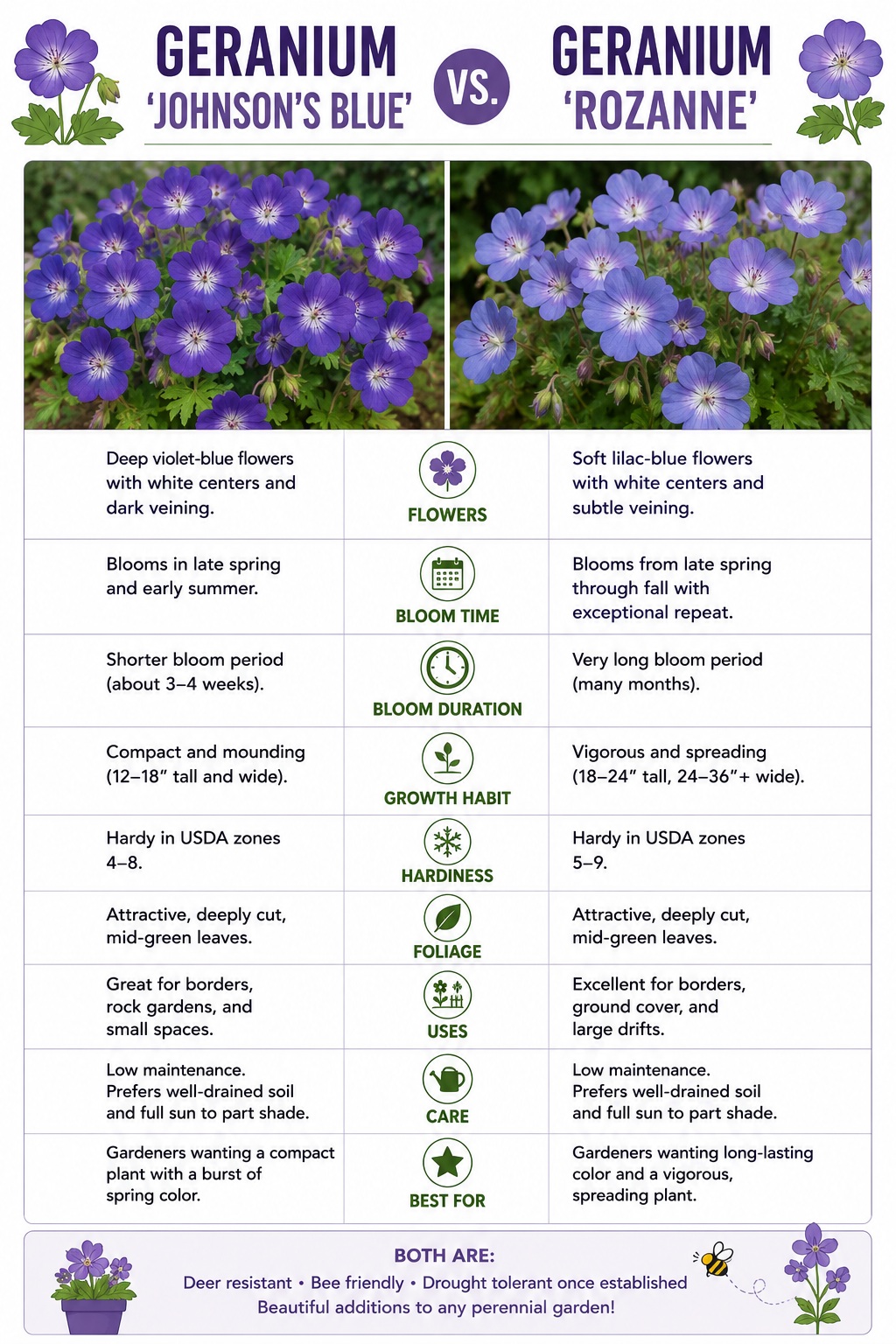
5. Head-to-Head Comparison Matrix
The following table summarizes the practical differences between these two leading hardy geranium cultivars.
| Landscape Feature | Geranium ‘Johnson’s Blue’ | Geranium ‘Rozanne’ |
| Growth Habit | Compact, neat, upright mound | Sprawling, vining, loose groundcover |
| Mature Size (H x W) | 15″x24″ (38x60cm) | 18″x36″+(45x90cm) |
| Bloom Window | Late Spring to Early Summer (3–4 weeks) | Late Spring through Late Autumn (Continuous) |
| Flower Identity | Uniform lavender-blue, clear core | Intense violet-blue with a striking white eye |
| Mid-Summer Shearing | Mandatory to clear floppy, spent stems | Optional; self-cleaning and holds shape |
| Heat & Humidity Index | Moderate; can fade or scorch in deep summer | Exceptional; thrives in humid, hot conditions |
| Best Landscape Use | Structured mid-border color, tight groupings | Groundcover, underplanting roses, hanging baskets |
6. Landscape Design: How to Position Each Cultivar
Because these cultivars grow in completely different shapes, substituting one for the other in a garden plan can ruin your design layout. Here is how to utilize their unique growth habits effectively.
Where to Plant ‘Johnson’s Blue’
Use ‘Johnson’s Blue’ in structured, formal, or traditional cottage borders where you need predictable shapes and heights.
- Mid-Border Anchors: Plant it in the middle tier of a perennial bed alongside pink peonies, white foxgloves, and yellow Siberian irises. The geranium’s explosive June bloom will complement these classic early-summer flowers beautifully.
- Interplanting for Cover: Because you will need to cut ‘Johnson’s Blue’ back to the ground in July, plant it directly behind late-summer performers like Echinacea (coneflowers) or Rudbeckia (Black-Eyed Susans). As the geranium retreats to grow fresh leaves, the late-summer perennials will step forward to fill the visual gap.
Where to Plant ‘Rozanne’
Think of ‘Rozanne’ as a living, weaving carpet. It excels in informal designs, challenging spaces, and multi-season borders.
- The Ultimate Rose Companion: Plant ‘Rozanne’ at the base of bare-legged shrub roses. Its long, vining stems will weave gracefully up through the lower thorny branches, covering bare wood with a carpet of violet-blue flowers that bloom in tandem with the roses all season.
- Slopes and Retaining Walls: Position ‘Rozanne’ along the top edge of a stone retaining wall or inside a large mixed container. Its lax stems will cascade over the edges, creating a waterfall of color.
- Choking Out Weeds: Because a single plant spreads over three feet wide, ‘Rozanne’ forms a dense, shadow-casting leaf canopy that naturally suppresses weed seeds from germinating along pathways and open garden beds.
Conclusion: Which One Wins a Place in Your Garden?
The battle between these two legendary hardy cranesbills comes down to what your landscape truly needs:
- Choose Geranium ‘Johnson’s Blue’ if you want a classic, well-behaved, clump-forming plant for a structured perennial border, prefer a softer lavender-blue color palette, and do not mind spending ten minutes shearing the plant back in July to keep your garden tidy.
- Choose Geranium ‘Rozanne’ if your priority is absolute maximum color value per square foot, need a tough groundcover to weave around roses, suppress weeds, or spill over walls, and want a low-maintenance plant that blooms without stopping for six straight months.
Both plants have earned their legendary status in gardening history. By matching their distinct genetic habits to your specific landscape goals, you can enjoy the very best qualities that hardy blue geraniums have to offer.
Quick Maintenance FAQ
1. Can I propagate ‘Rozanne’ by collecting its seeds?
No. ‘Rozanne’ is completely sterile and does not produce viable seeds. If you ever notice a seedling growing underneath your parent plant, it is likely a weed or a seedling from a non-sterile wild cranesbill nearby. To propagate ‘Rozanne’ legally for your own yard, you must carefully divide the root crown in early spring or take basal cuttings.
2. Why has my ‘Johnson’s Blue’ turned brown and collapsed in July?
This is completely normal behavior for this cultivar. After its intensive late-spring bloom, the old flowering stems naturally die back and flop open, exposing an empty center. Simply grab a pair of garden shears and cut the entire plant back to about two inches above the ground. Water it well, and within two weeks it will grow a fresh, compact mound of clean green leaves.
3. Does deer and rabbit wildlife eat these blue geraniums?
Fortunately, no. True hardy geraniums produce natural essential oils within their foliage that give off a distinct, pungent herbal aroma when bruised or nibbled. Deer and rabbits find this scent highly unappealing, making both ‘Johnson’s Blue’ and ‘Rozanne’ excellent choices for open, unprotected rural properties.
4. Can ‘Rozanne’ grow successfully in full shade?
While ‘Rozanne’ will survive in full shade, its growth habit will change significantly. The stems will stretch out and become very long and sparse as they chase the light, and the overall flower production will drop drastically. For the best performance, ensure it receives at least four to six hours of direct sunlight daily.