Within the botanical family Cactaceae, few genera evoke as much historical, chemical, and legal intrigue as Lophophora. These spineless, slow-growing, button-like cacti are native to the arid regions of North America. For centuries, taxonomists, collectors, and indigenous communities have focused heavily on distinguishing between its two most prominent species: Lophophora williamsii and Lophophora diffusa.
While these two plants look nearly identical to an untrained eye, they diverge significantly in their geographic distribution, structural characteristics, reproductive biology, and internal chemical profiles. Understanding these distinctions is crucial, as one species is highly regulated worldwide due to its psychoactive alkaloid content, while the other is predominantly a collector’s item known for its unique appearance.
1. Taxonomic Background and Discovery
The classification of the genus Lophophora has a complex botanical history, marked by shifting names and debates over whether certain plants are distinct species or merely regional variations.
Lophophora williamsii (The Northern Type)
Commonly known as Peyote, Lophophora williamsii is the type species of the genus. It was first described scientifically in the 19th century under various names (including Anhalonium lewini) before being placed in the genus Lophophora by French botanist Léon Charles Albert Coult. It occupies a vast geographic territory stretching from the Chihuahuan Desert of northern and central Mexico up into the Rio Grande Valley of South Texas.
Lophophora diffusa (The Southern Type)
Lophophora diffusa was recognized as a completely separate species much later, officially described by Heinrich Heiting in 1967. The species name diffusa directly references the “diffuse” or poorly defined nature of its physical ribs. This species is endemic to a highly isolated, southern pocket of Mexico, specifically within the semi-desert zones of Queretaro state.
2. Morphology: Physical Differences at a Glance
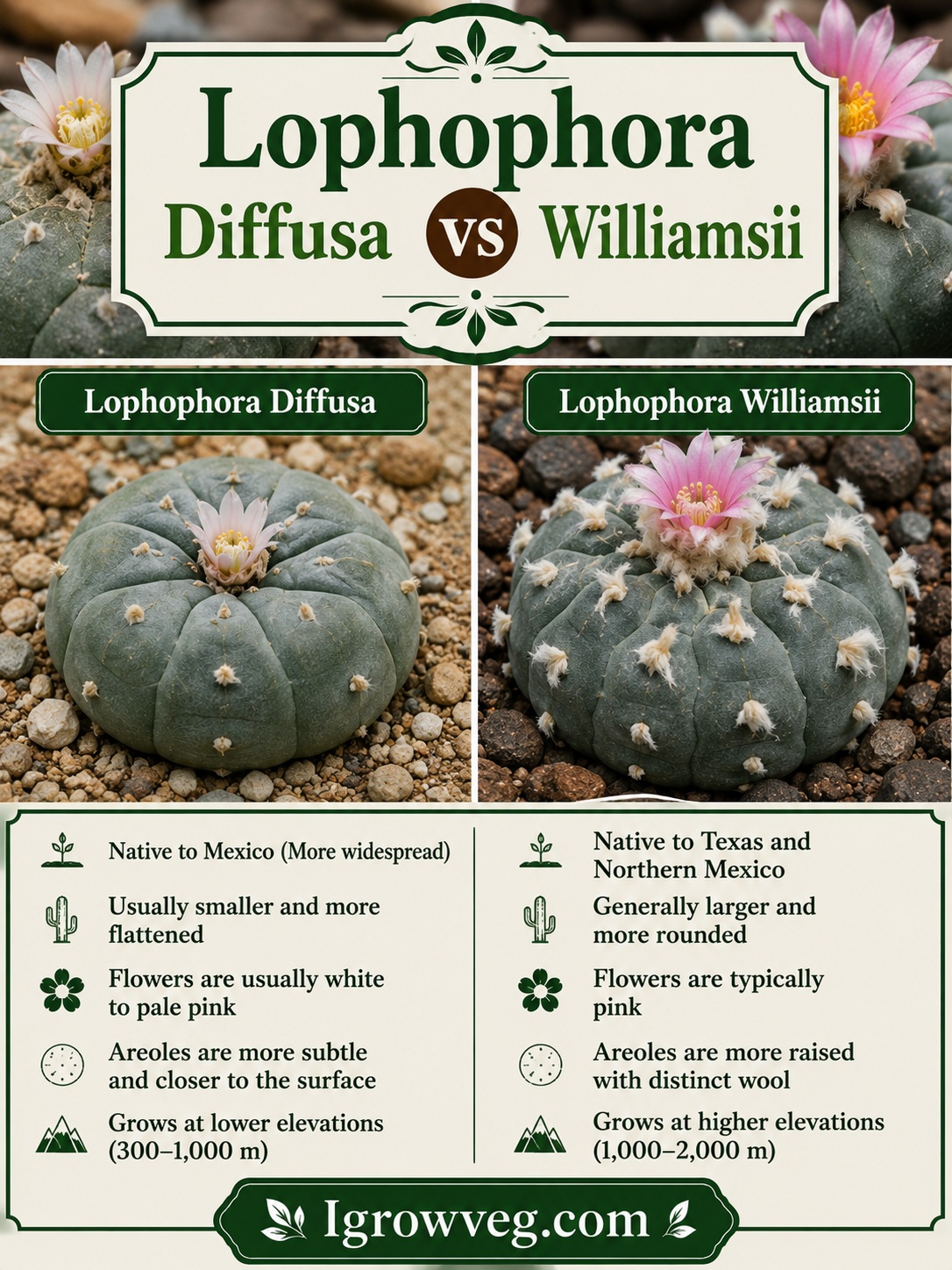
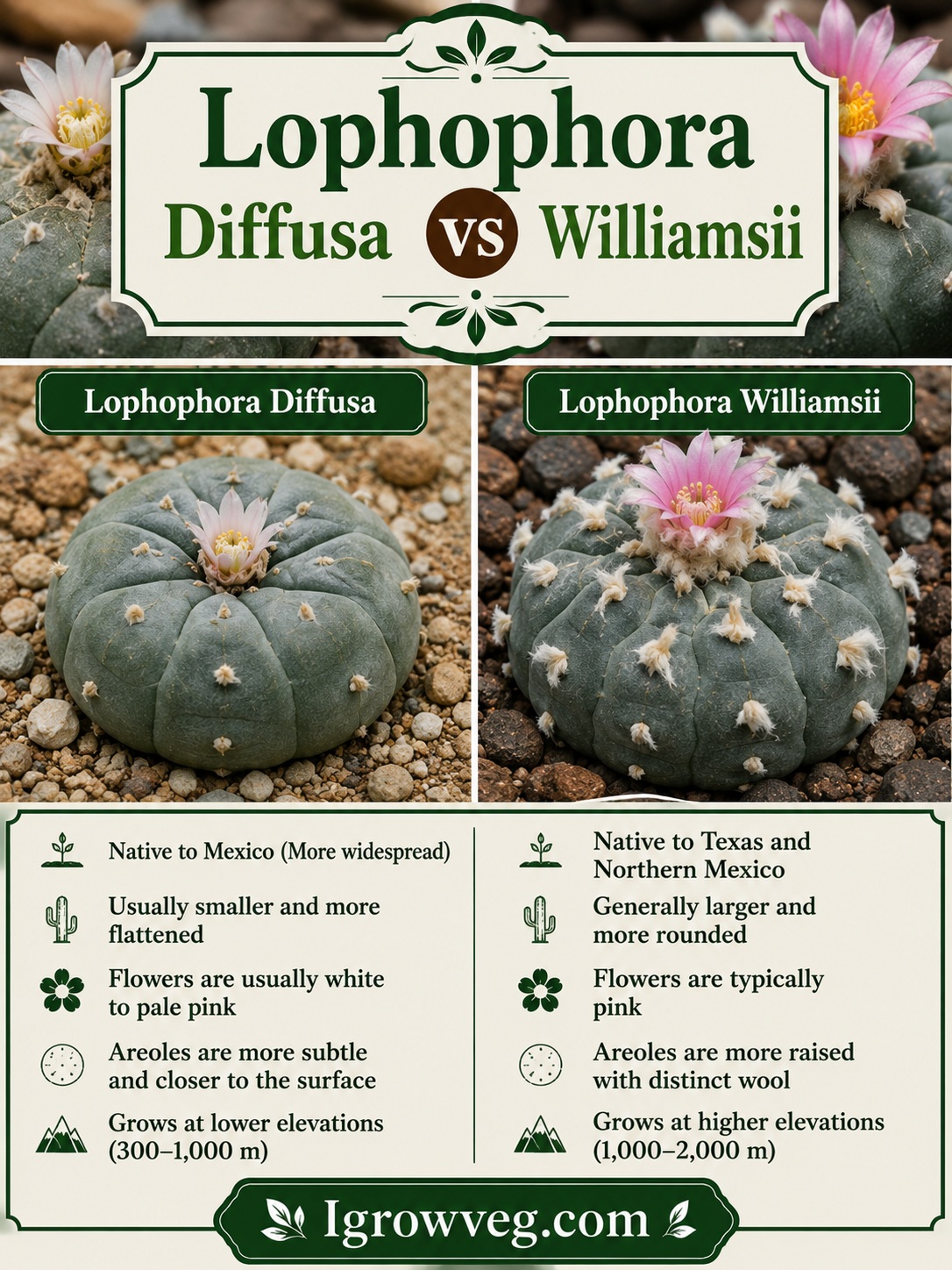
Telling these two cacti apart by their green, fleshy bodies (pods) requires looking closely at their ribs, skin texture, and color. When plants are young, they can look identical. However, as they reach maturity, their distinct physical features become much more obvious.
Rib Structure and Sinuosity
The most reliable physical indicator between the two species is how their vertical segments, or ribs, are formed:
- L. williamsii: Possesses well-defined, straight vertical ribs. Mature specimens typically exhibit 5 to 13 distinct ribs separated by deep, straight geometric lines (grooves). The buttons feature distinct, puckered bumps along these lines where the woolly areoles grow.
- L. diffusa: Lacks straight vertical ribs entirely. Instead, its ribs are highly irregular, undulating, and wavy. The surface appears “diffuse,” with shallow grooves that wind randomly across the plant’s surface. This creates a soft, bumpy texture rather than a segmented look.
Color and Epidermal Texture
The skin (epidermis) of each cactus reacts differently to light and possesses a distinct natural shade:
- L. williamsii: Displays a distinctly glaucous, blue-green, or grayish-green skin color. Under intense sunlight, it often develops a powdery white or silvery sheen. The flesh feels quite firm to the touch under proper watering conditions.
- L. diffusa: Features a yellow-green, lime-green, or apple-green skin color. It completely lacks the blue or gray tones seen in its northern relative. Furthermore, the skin texture is noticeably softer, more succulent, and less elastic to the touch.
Areoles and Wool
Because these cacti lack spines, their areoles produce soft tufts of hair-like wool:
- L. williamsii: Areoles are evenly spaced along its straight ribs, creating uniform, vertical rows of white-to-gray wool tufts.
- L. diffusa: Areoles are distributed more randomly across its wavy, uneven bumps, giving the plant a less structured, more wild appearance.
3. Floral Biology and Reproductive Strategy
When physical identification proves difficult, looking at the flowers provides a definitive answer. The two species have completely different floral structures and reproductive behaviors.
Flower Color and Petal Morphology
- L. williamsii: Produces flowers that range from distinct pink to pale pinkish-white, often with a darker pink or reddish stripe running down the center of each petal. The petals are generally straight and symmetrical.
- L. diffusa: Produces flowers that are pure white, creamy-white, or a very pale yellowish-white. It is rare for a true L. diffusa to show any pink coloration in its petals.
Reproductive Mechanisms
The way these plants reproduce in the wild represents a major evolutionary split:
- L. williamsii is Autogamous (Self-Fertile): A single isolated L. williamsii flower can fertilize itself. Its internal anatomy allows pollen from its own anthers to easily land on its sticky stigma. As a result, indoor growers can easily harvest pink fruit capsules filled with black seeds from a single plant without manual cross-pollination.
- L. diffusa is Allogamous (Self-Sterile): This species requires cross-pollination between two genetically distinct individual plants to set seed. Its internal flower parts are arranged to prevent self-fertilization, depending instead on native desert bees and insects to carry pollen between neighboring cacti.
4. Phytochemistry: The Alkaloid Divide
The most significant difference between Lophophora williamsii and Lophophora diffusa lies deep within their chemical makeup. Both species produce a complex cocktail of more than 50 distinct nitrogenous compounds called alkaloids, but their proportions are completely different.
The Mescaline Disparity
- L. williamsii: This species uses mescaline as its primary defense compound. In dried buttons, mescaline can account for up to 1% to 6% of the total dry weight. This compound is a potent psychedelic phenethylamine that triggers vivid sensory changes by interacting with serotonin receptors in the brain.
- L. diffusa: Contains almost zero mescaline. Chemical analyses show that mescaline makes up less than 0.01% of its total alkaloid profile—a trace amount that has no psychoactive effect.
Pellotine Dominance
Instead of mescaline, Lophophora diffusa directs its energy toward producing an entirely different compound:
- The Substitute: The main alkaloid in L. diffusa is pellotine, an isoquinoline alkaloid that makes up over 65% to 90% of its total chemical profile.
- The Effect: Pellotine is not a psychedelic compound. Instead, it is a hypnotic sedative that lowers body temperature and causes drowsiness. Consuming L. diffusa does not cause psychedelic visions; rather, its high concentration of pellotine and other trace compounds makes it highly toxic, causing severe nausea, stomach cramps, and physical sickness.
5. Summary Comparison Matrix
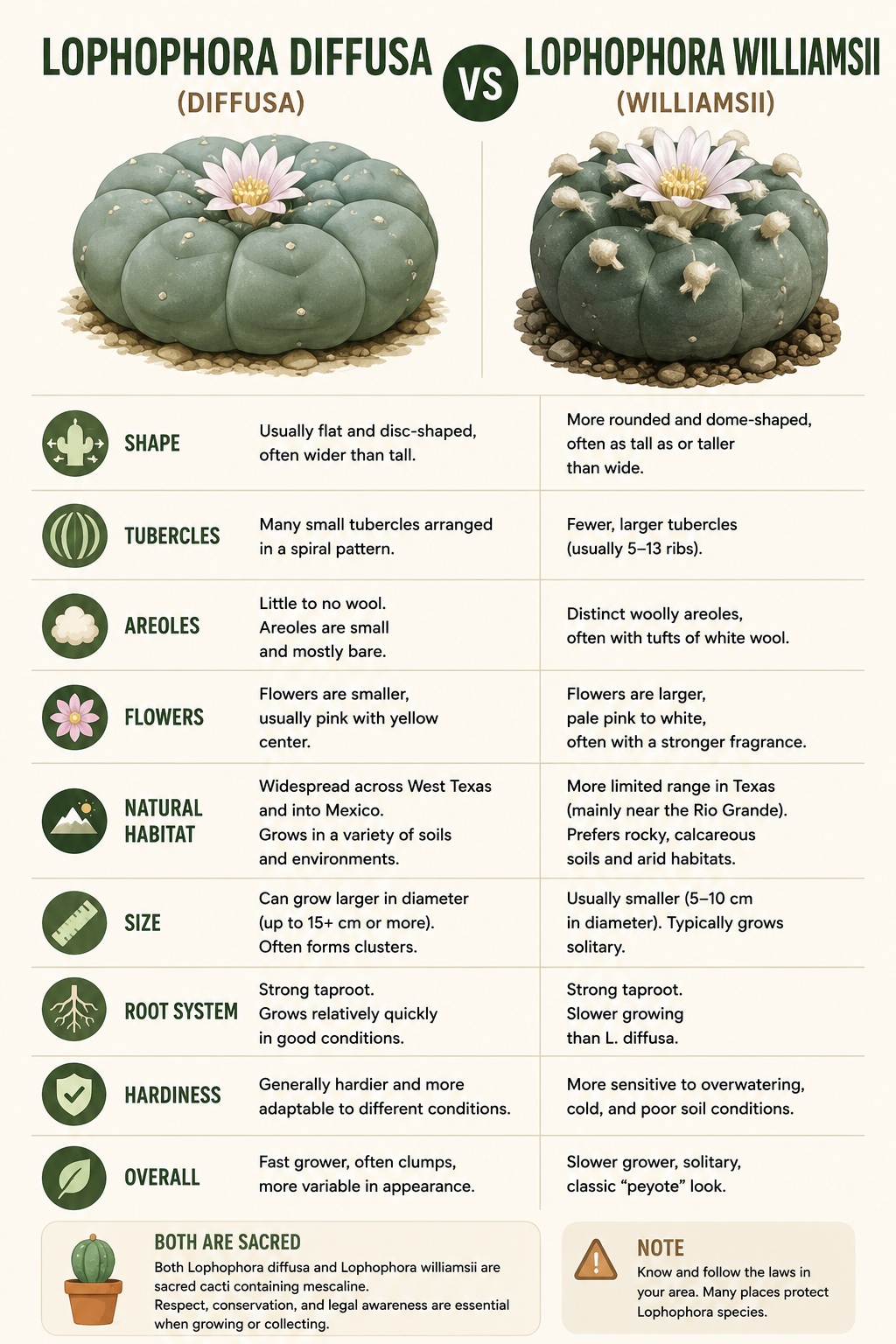
| Feature | Lophophora williamsii (Peyote) | Lophophora diffusa |
| Native Range | Chihuahuan Desert (Northern/Central Mexico, South Texas) | Queretaro, Mexico (Isolated Southern valley) |
| Epidermal Color | Blue-green, slate gray, glaucous silver | Yellow-green, apple green, lime green |
| Rib Structure | 5 to 13 straight, well-defined vertical ribs | Irregular, wavy, undulating ribs without straight lines |
| Flower Color | Distinct pink to pinkish-white with darker center stripes | Pure white, cream, or pale yellowish-white |
| Reproduction | Self-fertile (Autogamous); fruits readily set alone | Self-sterile (Allogamous); requires cross-pollination |
| Primary Alkaloid | Mescaline (Psychoactive phenethylamine) | Pellotine (Non-psychoactive isoquinoline) |
| Legal Status | Highly regulated/Schedule I in most global jurisdictions | Generally legal to possess as an ornamental plant |
6. Habitat, Ecology, and Conservation Status
Both species are highly adapted to surviving in harsh, arid desert environments, but they face very different ecological challenges.
Soil and Climate Preferences
- L. williamsii grows across a massive geographic footprint. It thrives in calcium-rich, alkaline limestone soils, often growing tucked beneath the shade of nursery shrubs like Agave lechuguilla or creosote bushes to protect itself from frost and intense summer heat.
- L. diffusa is confined to a single, small river valley basin in Queretaro. It grows on steep, shaly limestone cliffs and alluvial slopes, enduring much hotter, drier conditions year-round than its northern cousin.
Conservation Threats
The International Union for Conservation of Nature (IUCN) lists both species as facing significant survival risks, driven by two very different human activities:
Poaching vs. Habitat Loss: While L. williamsii populations are severely depleted by illegal poaching for its psychoactive properties, L. diffusa faces extinction primarily due to habitat destruction. Because its native range is so small, local mining operations, agricultural expansion, and dam construction can easily wipe out entire wild populations.
7. Legal and Regulatory Status
The vast chemical difference between these two plants directly shapes how they are treated under international law.
Lophophora williamsii
Because it contains high levels of mescaline, L. williamsii is classified as a Schedule I controlled substance in the United States and faces strict bans in countries like Canada, Mexico, Germany, and Australia.
- The Exception: In the United States, federal law grants narrow exemptions to members of the Native American Church (NAC). This allows them to legally harvest, transport, and use Peyote in traditional religious ceremonies, recognizing it as a sacred sacrament used for centuries before modern borders existed.
Lophophora diffusa
Since it lacks psychoactive mescaline, L. diffusa is generally legal to possess, trade, and cultivate as an ornamental plant in most countries around the world. However, international shipments still require strict CITES (Convention on International Trade in Endangered Species) documentation. This paperwork is necessary to prove the cactus was grown in a nursery rather than poached from the wild, helping protect endangered wild populations from being exploited by the exotic plant trade.
Conclusion
While Lophophora williamsii and Lophophora diffusa share a common lineage and a similar spineless shape, they are completely different plants under the surface. L. williamsii stands out for its neat, straight ribs, pink flowers, self-fertile reproduction, and rich history of ceremonial use driven by its mescaline content. Meanwhile, L. diffusa is defined by its soft, wavy ribs, white flowers, and a unique chemical makeup dominated by sedative pellotine.
For botanists and indoor growers alike, learning to spot these subtle differences in color, rib shape, and flower structure is essential for navigating the complex world of these fascinating desert survivalists.
Quick FAQ
1. Can you tell the difference between these two species when they are tiny seedlings?
No, it is nearly impossible to tell them apart when they are under a year old. Young seedlings of both species appear as tiny, round green spheres without distinct ribs. Their identifying features—like L. williamsii’s straight grooves or L. diffusa’s wavy bumps—only begin to show after 2 to 3 years of careful growth.
2. Is Lophophora diffusa psychoactive?
No, Lophophora diffusa is not psychoactive. It lacks the necessary amount of mescaline to cause psychedelic experiences. Instead, it is dominated by pellotine, a compound that causes physical sickness, intense nausea, and drowsiness rather than visual or mental changes.
3. How fast do these cacti grow from seed?
Both species are incredibly slow growers when raised on their own roots. In the wild, it can take anywhere from 10 to 15 years for a button to reach the size of a golf ball. However, indoor growers often speed up this timeline by grafting young seedlings onto fast-growing host cacti, such as Trichocereus or Pereskia, which can compress years of natural growth into just a few months.
4. Why is Lophophora diffusa yellow-green compared to williamsii?
This color difference comes down to genetics and adaptation. L. diffusa evolved in a hotter, more isolated region of central Mexico, where its lime-green skin helps it manage light absorption in that specific environment. On the other hand, L. williamsii’s blue-gray coating acts as a natural sunblock, helping it survive across a much wider, more varied geographic footprint.
5. Do these cacti ever grow spines?
Only as tiny seedlings. Right after germination, infant Lophophora sprouts will grow tiny, soft bristles to protect themselves. However, as the plant matures and develops its first true areoles, it stops producing these bristles entirely, replacing them with the iconic tufts of soft wool that define the mature genus.