

Finding that your tomato seedlings have become thin, pale, and “all legs” is a common challenge for many gardeners, particularly those starting seeds indoors. This condition, known scientifically as etiolation, occurs when the plant stretches its stem excessively in a desperate search for light. While a leggy tomato plant looks fragile, tomatoes possess a unique biological superpower: the ability to grow roots from any point along their stem.
This makes them one of the few garden crops that can be “fixed” even after a poor start. Understanding why this happens and how to utilize the plant’s anatomy to your advantage is the key to transforming a weak seedling into a robust, high-yielding producer.
1. Leggy vs. Healthy Seedlings: Identifying the Problem
The first step in management is recognizing the difference between a high-performing plant and one that is struggling.
- Healthy Seedlings: These plants are stocky and compact. The stems are thick—often with a purple or dark green tint—and the leaves are spaced closely together. A healthy seedling doesn’t need support to stay upright.
- Leggy Seedlings: These appear “spindly” or stretched. The distance between the leaves (the internodes) is long, and the stem is thin and often pale green or white. These plants frequently flop over under their own weight or when exposed to a light breeze.
If your plants are leaning significantly toward a window or have reached several inches in height with only two tiny seed leaves at the top, they are experiencing legginess.
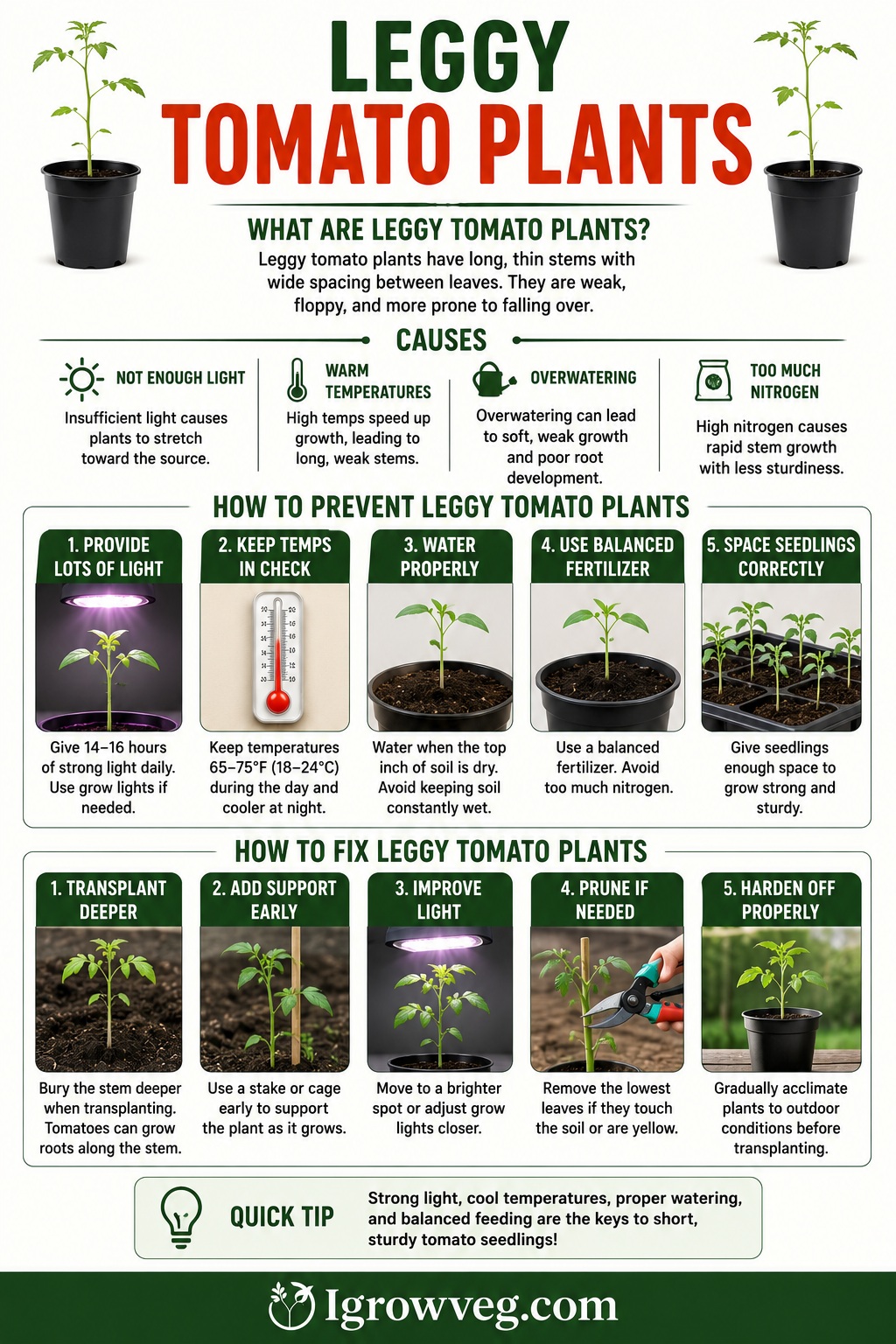
2. Why Are My Tomato Plants Long and Spindly?
Legginess is almost always an environmental response rather than a disease. There are three primary triggers:
Insufficient Light
This is the most common cause. If the light source is too far away or too weak, the plant produces gibberellins (growth hormones) that cause the cells in the stem to elongate rapidly to reach the light. Indoor windowsills often provide “one-sided” light, which causes the plants to stretch and lean.
Excessive Heat
High temperatures, especially at night, encourage rapid, soft growth. If your grow room or greenhouse is too warm but the light is moderate, the plant grows faster than its structural integrity can keep up with.
Overcrowding
When seedlings are planted too close together, they compete for light. As they begin to shade one another, each plant tries to outgrow its neighbor to reach the sun, resulting in a cluster of thin, weak plants. To learn more about the botanical competition for resources in vegetable gardens, The Royal Horticultural Society provides extensive research on plant spacing and light interception.
3. How to Fix Leggy Tomato Plants: The “Deep Bury” Method
The most effective way to save a leggy tomato is to bury the elongated stem. Because tomatoes have “adventitious roots,” the buried portion of the stem will transform into a massive, vigorous root system.
The Deep Hole Method
If you are transplanting into a large pot or into the garden, dig a hole deep enough to bury the plant up to the first set of true leaves. Remove the bottom-most seed leaves (cotyledons) before burying. This provides the plant with a sturdier base and immediate access to more soil nutrients.
The Trenching Method (For Extremely Leggy Plants)
If the plant is too long to bury vertically without digging to the “center of the earth,” use the trenching method. Dig a shallow trench about 3 inches deep. Lay the tomato plant on its side in the trench, gently curving the top of the plant upward so the leaves are above the soil. Cover the horizontal stem with soil. Within days, the top will grow straight up, and the entire buried stem will sprout new roots. For technical advice on soil temperature and its impact on root initiation, NCSU offers deep-dive guides on Solanum lycopersicum physiology.
4. How to Get Thick Stems on Tomato Plants
Prevention is better than a cure. To ensure your next batch of seedlings grows thick and “beefy” stems from the start, follow these steps:
- Lower the Lights: If using grow lights, keep them just 2 to 3 inches above the tops of the seedlings. Move the lights upward as the plants grow.
- Use a Fan: Place a small oscillating fan near your seedlings for 15 minutes a day. The physical stress of the “wind” signals the plant to strengthen its stem by producing more lignin.
- Control the Temperature: Keep daytime temperatures around 21°C and drop them to 15°C at night. This mimics natural cycles and discourages “soft” stretching.
- Brush the Plants: Simply running your hand over the tops of the seedlings daily simulates physical contact, which triggers a hormonal response (thigmomorphogenesis) that results in shorter, thicker stems.
5. Summary: Healthy vs. Leggy Management
| Feature | Healthy Seedling | Leggy Seedling | Fix/Prevention |
| Stem Thickness | Thick, sturdy, often purple. | Thin, fragile, pale green. | Bury stem up to true leaves. |
| Leaf Spacing | Nodes are close together. | Long gaps between leaves. | Increase light intensity/duration. |
| Stability | Stands upright independently. | Flops over or leans heavily. | Use a fan to simulate wind. |
| Root Potential | Standard root ball. | Potential for massive roots. | Trench or bury horizontally. |
Conclusion
Leggy tomato plants are not a death sentence for your garden. In fact, by burying those long, spindly stems, you often end up with a plant that has a more robust root system than a “perfect” seedling that was planted shallowly. By adjusting your lighting, managing your temperatures, and utilizing the tomato’s natural ability to grow roots along its stem, you can rescue almost any leggy seedling. Remember that the goal is a thick, dark green stem that can support the weight of heavy fruit later in the season. With a few structural adjustments at the transplant stage, your leggy plants can recover fully and go on to produce a spectacular harvest.
FAQ: Frequently Asked Questions
1. Can you fix leggy tomato plants by tying them up?
Tying them to a stake provides temporary support, but it does not fix the weak stem. It is better to bury the stem so it can grow roots and become structurally sound.
2. Why are my tomato plants long and spindly?
This is almost always due to a lack of light. The plant is stretching to find a better light source.
3. How deep can you plant leggy tomatoes?
You can bury them right up to the first set of “true” leaves. Do not worry about burying the stem; it will not rot; it will grow roots.
4. Can you cut the tops off of leggy tomato plants?
No. Cutting the main growing tip (the leader) will stunt the plant and delay fruit production. It is much better to bury the excess stem.
5. Can I bury leggy tomato stems?
Yes! This is the recommended fix. Tomatoes are unique in their ability to grow “adventitious roots” from their stems when covered with soil.
6. How to fix a leggy tomato plant?
The best fix is to transplant it deeper into the soil or use the “trenching” method to bury the long stem horizontally.
7. Can leggy seedlings recover?
Absolutely. Once they are planted deeply and given proper light, they will quickly catch up and become healthy, productive plants.
8. Can leggy tomato seedlings be saved?
Yes. As long as the stem isn’t snapped or diseased, burying the “legs” will save the plant and actually give it a larger root system.
9. How far should grow lights be from tomato seedlings?
To prevent legginess, keep LED or fluorescent grow lights 2 to 4 inches away from the tops of the plants.
10. What is the “trenching” method for tomatoes?
Trenching involves digging a long, shallow furrow and laying the leggy plant sideways in it, covering the stem with soil and leaving only the top leaves exposed.