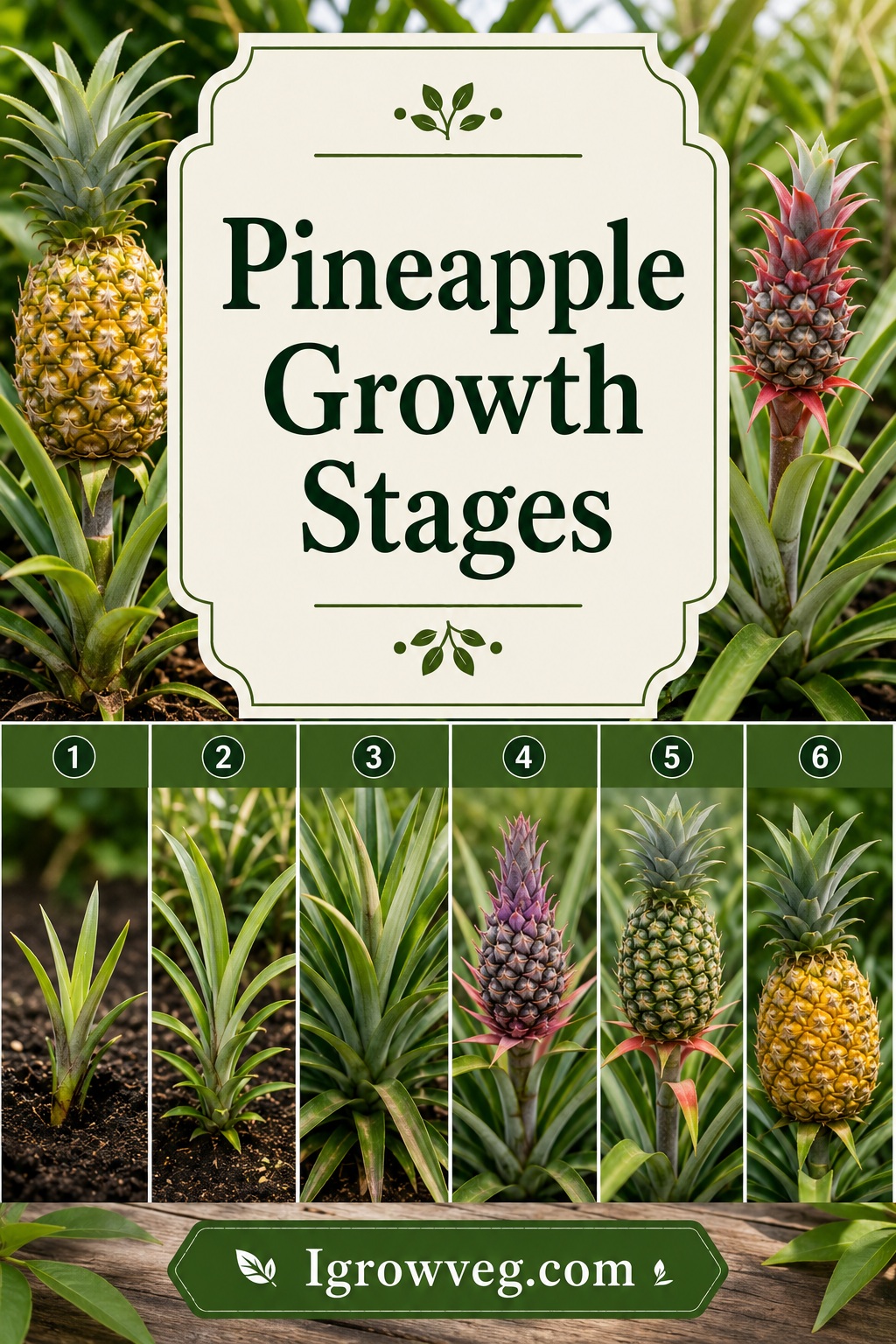
The pineapple growth stages represent one of the most unique and patient journeys in the world of home gardening. Unlike most fruits that grow on trees, the pineapple (Ananas comosus) is a terrestrial bromeliad that produces a single, magnificent fruit from its center. This tropical marvel does not rely on traditional seeds for common cultivation; instead, it regenerates from its own leafy top or side shoots.
Understanding the timeline of this plant is essential because it is a marathon, not a sprint, often taking up to two years to reach fruition. From the first roots emerging from a grocery-store crown to the final aromatic ripening, each phase requires specific care to ensure a sweet result. In this guide, we will explore the biological transitions of the pineapple, helping you navigate the slow but rewarding development of this iconic tropical fruit.
🍍 Pineapple Plant Growth Stages
- Seed Germination / Propagation (0–2 months) Pineapples are usually propagated from crowns, slips, or suckers rather than seeds. Roots establish and the first leaves emerge.
- Seedling Stage (2–6 months) Rosette of spiny leaves develops; plant focuses on root and leaf growth.
- Vegetative Growth (6–12 months) Leaves elongate and form a dense rosette; plant height increases; strong root system supports future fruiting.
- Mature Vegetative Stage (12–18 months) Plant reaches full size (60–120 cm tall); energy stored in leaves prepares for flowering.
- Flower Initiation (18–24 months) Central stem produces a flower stalk; hundreds of small purple-red flowers appear.
- Fruit Development (24–30 months) Individual flowers fuse into a single composite fruit; green pineapple enlarges and matures.
- Ripening Stage (30–36 months) Fruit turns yellow/golden; sugars increase, acidity balances; ready for harvest.
- Post-Harvest / Sucker Growth (36+ months) Mother plant produces suckers and ratoons (side shoots) that can be replanted for new crops.
🌿 Notes:
- Pineapples are perennial bromeliads, but each plant produces only one fruit per cycle.
- Commercial plantations stagger planting to ensure continuous harvests.
- Ideal climate: tropical, warm (20–30°C), with well-drained sandy loam soil.
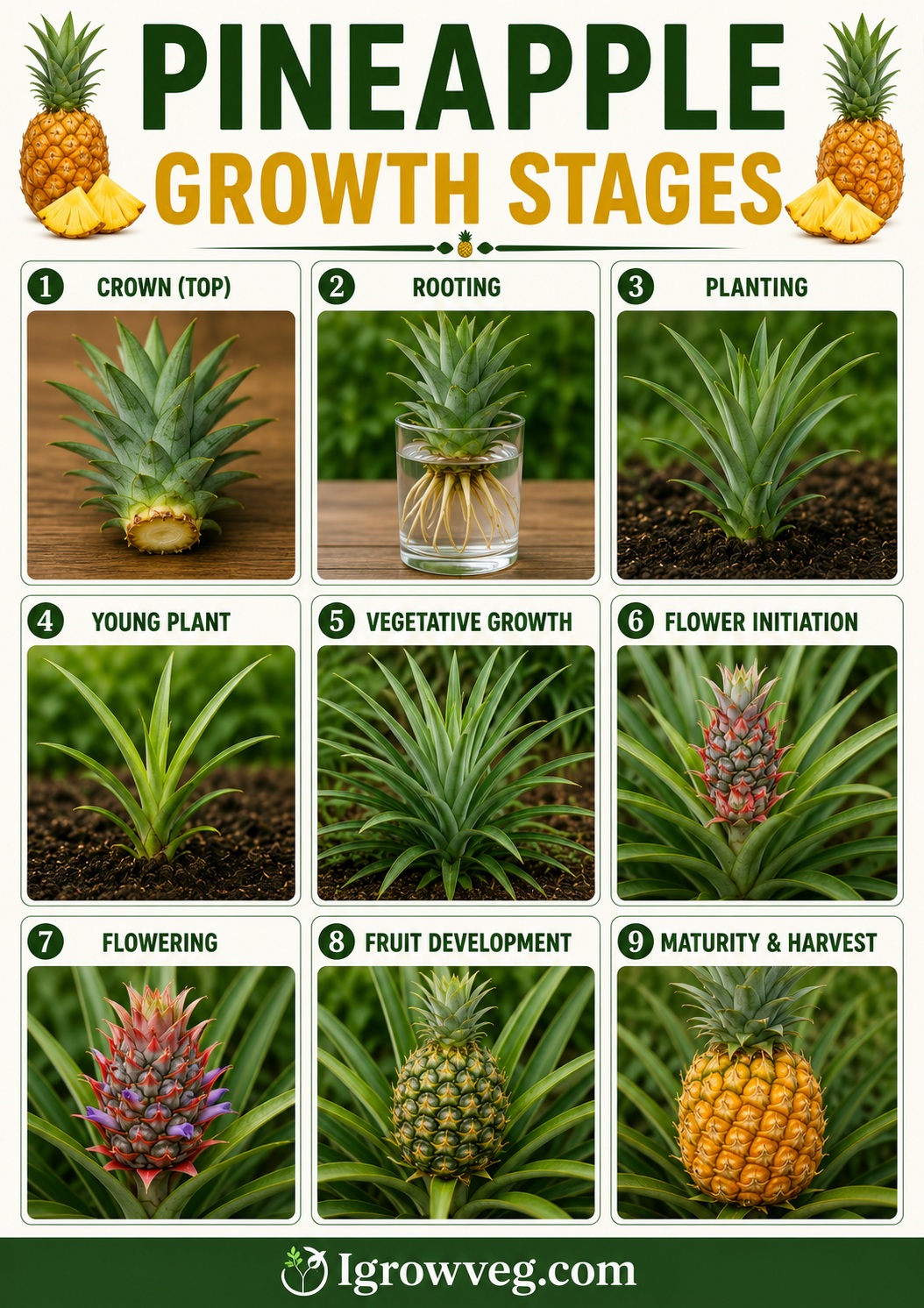
1. Propagation and Rooting: The Starting Point
The first of the pineapple growth stages begins with a “starter.” While you can use seeds, almost all gardeners start with a crown (the top of a fruit), a slip, or a sucker.
Preparing the Crown
To start with a crown, you must twist it off a ripe pineapple and strip away the bottom few layers of leaves to expose the “primordia” or small root nubs. It is critical to let the base dry for two to three days to prevent rot. Once callused, you can place the base in water or directly into a sandy, well-draining soil mix.
The Rooting Phase
During the first 6 to 8 weeks, the plant focuses entirely on establishing a root system. You will not see much movement above ground, but beneath the soil, the plant is building the foundation needed to support its heavy future. For detailed instructions on the best soil pH for bromeliads, The Royal Horticultural Society provides excellent resources on tropical soil management.
2. Vegetative Growth: Building the Bromeliad Frame
Once the roots are established, the plant enters the vegetative phase. Among all pineapple growth stages, this is the longest period, lasting anywhere from 12 to 20 months.
Leaf Development and Water Storage
The pineapple grows in a “rosette” pattern, with long, sword-like leaves emerging from a central point. These leaves are designed to act as funnels, catching rainwater and directing it into the center of the plant. Interestingly, pineapples can absorb nutrients through their leaves as effectively as through their roots.
Sizing Up
During this phase, the plant requires significant nitrogen to fuel its expansion. A healthy pineapple plant can reach 3 to 4 feet in width and height. It is vital to provide plenty of space and bright, direct sunlight. If the plant is shaded, the leaves will become dark green and thin, and it may never move to the flowering stage.
3. Induction and Flowering: The “Red Heart” Emerges
The transition to the reproductive part of the pineapple growth stages is often triggered by the age of the plant or a drop in temperature.
The Emergence of the Inflorescence
After the plant has produced around 30 to 50 leaves, a cluster of small, reddish leaves appears in the center. This is known as the “red heart” stage. Soon, a stalk emerges with a structure that looks like a miniature pineapple covered in tiny purple or blue flowers.
The Multi-Fruit Miracle
A pineapple is actually a “multiple fruit.” Each tiny flower produces a fruitlet, and as these fruitlets grow, they fuse together around the central core to form a single large fruit. This process is fascinating to watch and signals that the harvest is finally on the horizon. For more on the complex anatomy of tropical fruits, University of Florida IFAS Extension offers deep-dive botanical research.
4. Fruit Development and Ripening: The Golden Finish
The final of the pineapple growth stages involves the swelling and sweetening of the fused fruitlets.
Maturation Timeline
From the time the flowers fade, it takes about 5 to 7 months for the fruit to reach full size. During this stage, the plant needs consistent water and high levels of potassium. If the plant dries out during fruit development, the resulting pineapple will be small and fiber-rich rather than juicy.
The Scent of Success
A pineapple is ready for harvest when the skin changes from green to a golden-yellow hue, starting from the base and moving upward. The most reliable indicator of ripeness is the aroma; a mature pineapple will smell intensely sweet at the base. Unlike some other fruits, pineapples do not get any sweeter once they are picked, so timing the harvest correctly is essential for flavor.
5. Summary of Pineapple Development Milestones
| Stage | Approximate Timeline | Key Care Requirement |
| Rooting | 0–2 Months | Callusing the base and high humidity. |
| Vegetative | 2–18 Months | Direct sun and nitrogen-rich feeding. |
| Flowering | 18–22 Months | “Red heart” monitoring and potassium. |
| Fruiting | 22–26 Months | Consistent moisture for juice development. |
| Harvest | 26+ Months | Wait for golden color and sweet aroma. |
Conclusion
The pineapple growth stages are a testament to the rewards of slow gardening. While waiting over two years for a single fruit may seem daunting, the taste of a sun-ripened, homegrown pineapple is incomparable to store-bought versions. By providing a stable, warm environment and respecting the plant’s need for a long vegetative “recharging” period, you ensure a successful harvest. Once you pick your golden fruit, remember that the plant often produces “suckers” or “pups” at its base, allowing you to start the cycle again with an even stronger head start.
FAQ: Frequently Asked Questions
1. Can I grow a pineapple from a store-bought top?
Yes, as long as the crown is healthy and the center leaves are still green, you can root it and grow a new plant.
2. Why is my pineapple plant not flowering?
The plant may not be old enough, or it may not be receiving enough direct sunlight to trigger the induction phase.
3. How much sun does a pineapple plant need?
They are true sun-lovers and require at least 6 to 8 hours of direct, intense sunlight daily.
4. Can I grow a pineapple indoors?
Yes, but it must be placed in a very sunny window or under strong grow lights to mimic tropical conditions.
5. How often should I water my pineapple?
Water about once a week, or when the top inch of soil is dry. They are drought-tolerant but need moisture for fruit growth.
6. Do pineapples die after they fruit?
The main plant will slowly decline, but it will typically produce several “pups” or suckers that you can replant.
7. How do I know if my pineapple is ripe?
Look for a change in color from green to yellow-gold and a sweet, tropical scent at the base of the fruit.