Few things in gardening are as frustrating as staring at a pepper plant loaded with full-sized, glossy… green peppers. Weeks pass, summer starts to slip into autumn, and those stubborn bells, jalapeños, or habaneros refuse to transition to that vibrant, sweet red you’ve been waiting for.
If you are currently pacing around your garden beds wondering what you did wrong, take a deep breath. Your plant isn’t broken. Changing color is a complex biological countdown dictated by genetics, temperature, sunlight, and nutrition.
This comprehensive guide breaks down the science of why peppers stall at the green stage, the structural timeline of ripening, and the actionable steps you can take to finally get them to turn red.
The Biological Timeline: Understanding the Crop Clock
To fix the problem, you first need to understand that every red pepper started out green. A green pepper is technically an immature fruit. Inside its walls, chloroplasts are actively performing photosynthesis, keeping the pepper green and giving it that sharp, grassy, slightly bitter flavor profile.
As the seeds inside mature, the plant triggers a chemical shift. It begins breaking down the green chlorophyll, replacing it with carotenoids and anthocyanins—the pigments responsible for brilliant reds, oranges, and yellows. At the same time, the plant converts starches into sugars, giving ripe peppers their characteristic sweetness.
However, this process takes time—often much longer than most gardeners realize.
[ Days 1-50 ] ➔ Fruit grows to full physical size (Green/Immature)
[ Days 51-65] ➔ Chemical shift begins; sugars rise, chlorophyll breaks down
[ Days 66-90] ➔ Full color transition to Red/Yellow/Orange (Mature)
The “Days to Maturity” Trap
When you buy a seed packet or a starter plant, look closely at the Days to Maturity (DTM) number.
- The Misunderstanding: If a bell pepper says “70 Days,” many gardeners expect red peppers 70 days after planting.
- The Reality: That number usually indicates how long it takes for the plant to produce its first edible green fruit from the date it was transplanted into the ground. For that fruit to transition to full red, you often need to add an extra 3 to 4 weeks of warm weather.
Top 5 Reasons Your Peppers are Staying Green
If your peppers have been full-sized for over a month and still show no signs of color, one of the following five factors is likely the culprit.
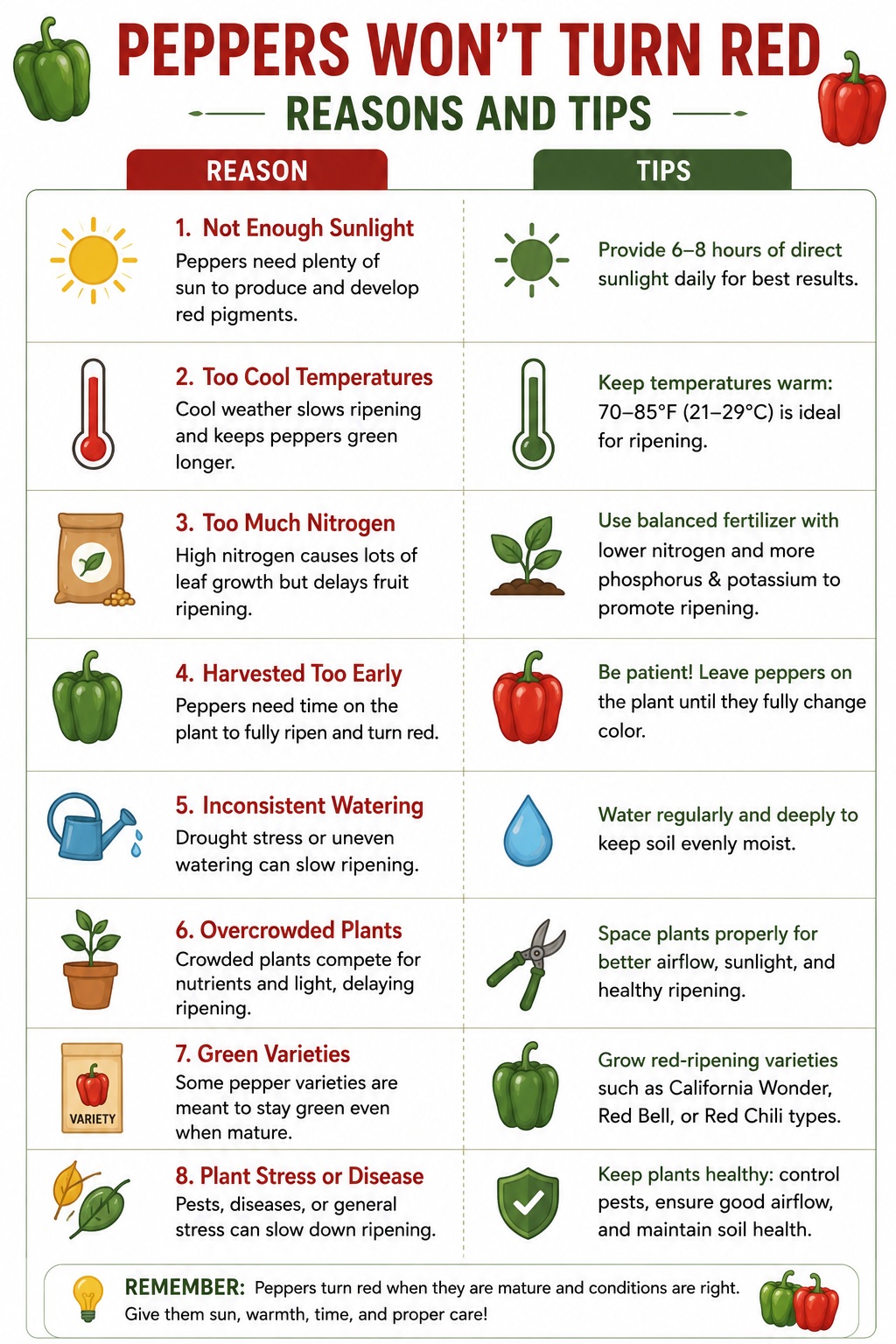
Reason 1: The Temperature Stagnation Zone
Peppers are notorious goldilocks crops; they require temperature ranges that are neither too hot nor too cold to synthesize the enzymes needed for color transitions.
- The Ambient Highs: If daytime temperatures consistently exceed 32°C (90°F), pepper plants experience heat stress. To survive, the plant enters a metabolic preservation mode, halting the ripening process.
- The Nighttime Lows: Conversely, if night temperatures drop below 13°C (55°F), the plant’s metabolism slows to a crawl. The biochemical pathways that produce red pigments essentially freeze in place.
Reason 2: Nutrient Imbalances (The Nitrogen Overload)
If you are feeding your pepper plants the same fertilizer you use for your lawn or leafy greens, you are delaying your harvest.
High-nitrogen fertilizers encourage the plant to manufacture lush green leaves and continuous vine growth. However, if the soil contains an excess of nitrogen during the fruiting phase, the plant “forgets” to ripen its existing fruit. Instead, it expends all its energy pushing out new foliage. To transition to red, peppers require a shift toward potassium and phosphorus, which support fruit development and maturity.
Reason 3: Sunlight Deprivation
While peppers do not necessarily need direct sunlight hitting the skin of the fruit to ripen (ripening is heavily driven by the plant’s internal temperature), the leaves of the plant require intense solar energy to fuel the sugar-making process. If your plants are shaded by taller crops like tomatoes or corn, the sugar levels in the fruit won’t reach the threshold required to trigger the chlorophyll breakdown.
Reason 4: Overwatering and Root Luxury
When a pepper plant receives a luxury supply of water and nutrients, it has no biological incentive to rush its seeds to maturity. Consistent overwatering keeps the plant in a relaxed, vegetative state. A slight amount of environmental stress is actually beneficial for accelerating the ripening process, as it signals to the plant that its lifespan may be limited, forcing it to finish its seeds (and turn red) quickly.
Reason 5: Variety Specifics
Simply put, some varieties take a massive amount of time to turn red.
- Thick-Walled Bells: Varieties like ‘King of the North’ or ‘California Wonder’ have dense, thick walls that require a high volume of sugars to transition. They take significantly longer than thin-walled varieties like cayenne or shishito peppers.
- The Impostors: Ensure you didn’t accidentally plant a variety meant to stay green or turn a different color entirely, such as a yellow bell or a specific strain of jalapeño bred to minimize “corking” (streaking) and stay green longer.
Quick Reference: Pepper Variety Timelines
| Pepper Type | Average Days to Green | Extra Days for Red Transition | Total Days from Transplant |
| Sweet Bell Peppers | 65 – 75 Days | 20 – 30 Days | 85 – 105 Days |
| Jalapeños | 60 – 70 Days | 15 – 25 Days | 75 – 95 Days |
| Cayenne | 70 – 80 Days | 10 – 15 Days | 80 – 95 Days |
| Habaneros | 75 – 90 Days | 25 – 35 Days | 100 – 125 Days |
How to Accelerate the Red Transition: Garden Strategies
If the season is winding down and you are staring at a sea of green, use these targeted tactics to force your plants into action.
1.Halt the Fertilizer:Late Summer.
Stop applying any high-nitrogen fertilizers immediately. If you must feed the plants, use a dilute organic fertilizer high in bone meal or potassium sulfate to signal that the vegetative growth phase is over.
2.The ‘Topping’ Technique:
Prune off the top growing tips of the pepper plant, along with any tiny, new flowers or miniature peppers that have zero chance of reaching full size before winter. This process forces the plant to redirect 100% of its remaining energy and sugars into ripening the mature green peppers already on the branches.
3.Regulate the Water Supply:Late Season.
Cut back your watering schedule slightly. Allow the top two inches of soil to dry out completely between waterings. This minor drought stress mimics the end of the natural growing season, stimulating the plant’s reproductive drive to ripen fruit.
4.Prune Lower Foliage:For Airflow & Light.
Trim away yellowing or excess lower leaves that block air circulation and cast deep shadows on the interior of the plant. Increasing the internal temperature of the plant canopy speeds up the enzymatic reactions required for color synthesis.
The Countertop Ripening Emergency Plan
If a sudden frost warning threatens your garden and your plants are still covered in green peppers, all hope is not lost. You can harvest them and finish the process indoors using natural ripening gases.
The Ripening Rule: Only peppers that have begun to show a “blush” of color (even a tiny streak of chocolate, purple, or pale yellow) will successfully ripen on the counter. Completely immature, bright green peppers picked early will simply wilt, soften, and rot without changing color.
The Paper Bag Trick
Peppers are climacteric or semi-climacteric fruits, meaning some varieties respond well to ethylene gas—the natural ripening hormone given off by decaying or ripening fruit.
- Harvest with Stems attached: Cut the peppers from the plant, leaving at least an inch of stem to prevent moisture loss and infection.
- The Companion Strategy: Place your blushing peppers inside a brown paper bag along with a ripe banana or a red apple. The banana or apple releases high concentrations of ethylene gas.
- The Environment: Seal the bag loosely and place it in a warm room (20-25°C / 68-77°F). Do not put them in the refrigerator, as cold temperatures halt ethylene production completely. Check the bag every 48 hours; within a week, your blushing peppers should turn a solid, brilliant red.
Conclusion: Is Green Really That Bad?
While you wait for your peppers to make their colorful debut, remember that green peppers are perfectly edible, crisp, and nutritious. They contain high levels of Vitamin C, though they lack the high Vitamin A concentrations and complex sweetness of their fully ripe red counterparts.
If you live in a northern climate with a short summer, getting large bell peppers to turn red completely on the vine can be an annual challenge. Next season, consider planting smaller pepper varieties like ‘Gypsy’, ‘Lipstick’, or sweet Italian frying peppers—their thinner walls require fewer sugars and significantly less time to make the glorious transition from green to red.
Quick FAQ
1. Do peppers need direct sunlight to turn red?
No. Sunlight fuels the leaves of the plant to create sugars, but the actual changing of color on the fruit is driven by temperature and maturity, not direct sun exposure on the skin. In fact, too much direct sun on exposed peppers can cause “sunscald,” which ruins the fruit.
2. Can I leave peppers on the vine after a frost?
No. A hard frost will turn the leaves to mush and damage the skin of the peppers, causing them to rot instantly. Harvest all full-sized peppers before the first freeze hits your area.
3. Why are my green jalapeños turning black/brown instead of red?
This is completely normal! Before a jalapeño or bell pepper turns red, it often goes through a dark purple, brown, or almost black “muddy” phase. This is just the visual blend of green chlorophyll breaking down while the red pigments are building up.
4. Why are my peppers small but already turning red?
If a pepper plant experiences severe stress (drought, root binding, or pest attacks) early in its life, it may dwarf the size of the fruit and force it to ripen early to guarantee seed survival.
5. Does epsom salt help peppers turn red?
Epsom salt provides magnesium, which aids in chlorophyll production and overall plant health. While it supports a healthy plant, it does not directly accelerate the speed of the color transition.